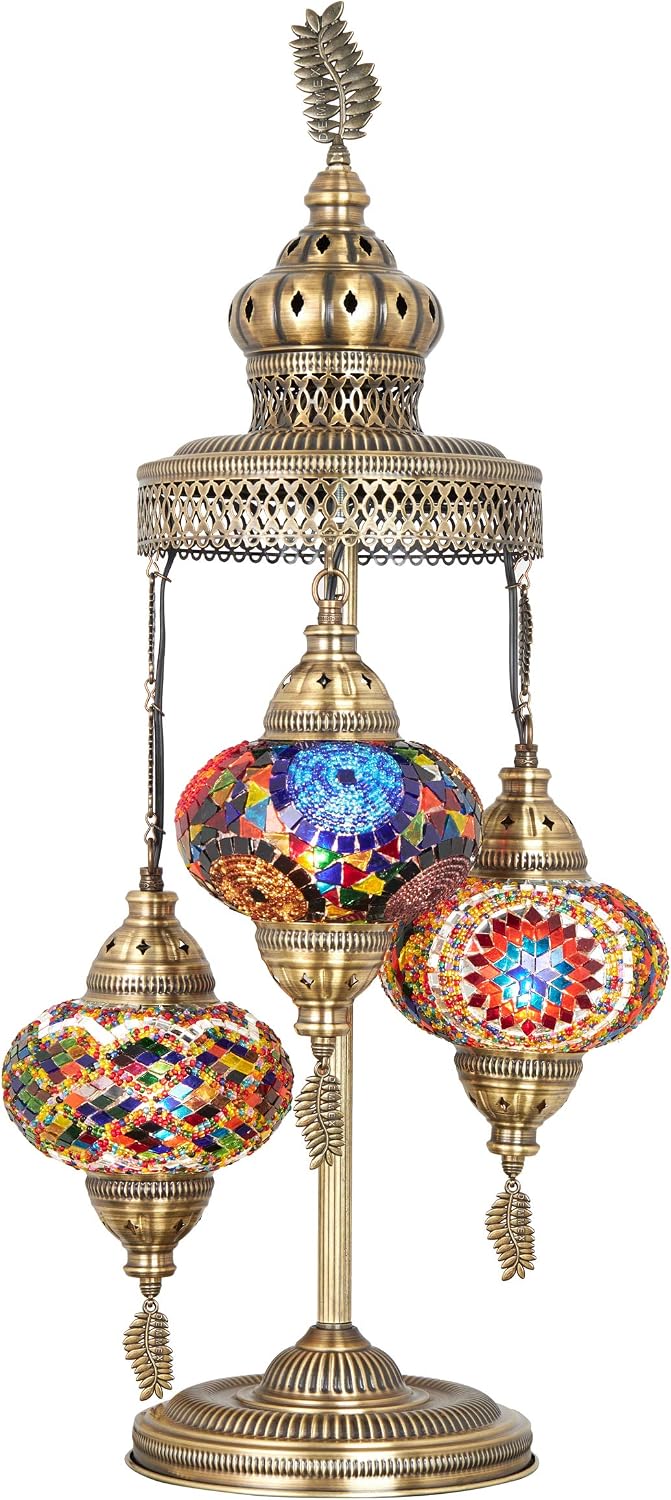
Picture this: you find a Turkish mosaic table lamp on Etsy — jewel-toned glass pieces set into a bronze-colored frame, photographs that look like stained-glass art nouveau, seller claiming “100% handmade in Istanbul.” Then you find another one on a mass-market site for forty dollars less that looks nearly identical in the thumbnail. Both describe themselves as “authentic.” One of them is. The other is a machine-stamped metal shell fitted with pre-cut uniform glass tiles, assembled in batches of five hundred. If you can’t tell them apart yet, you’re in exactly the right place.
Turkish mosaic table lamps — called fanous (فانوس) in Arabic, a word meaning “lantern” used across the broader region — are frame-and-glass constructions in which colored glass pieces are set into a metal armature, traditionally copper or brass, and lit from within so the glass glows. The Ottoman and Anatolian craft tradition behind them is distinct from Moroccan zellige work but has overlapped with it in the global market to the point where buyers routinely conflate the two. This guide is specifically about the Turkish form: what makes a lamp genuinely hand-cut and hand-set, how to interrogate a listing before you commit, and how to calibrate your budget against what the craft actually costs to produce honestly.
| EDITOR'S PICK[DEMMEX Turkish Moroccan Mosaic…](https://www.amazon.com/dp/B07K61XXGB?tag=greenflower20-20) | Mid-tier[DEMMEX 3-Globe Turkish Moroccan…](https://www.amazon.com/dp/B07HYZ3RVM?tag=greenflower20-20) | Budget pick[DEMMEX Turkish Moroccan Mosaic…](https://www.amazon.com/dp/B07HDF8M1B?tag=greenflower20-20) | |
|---|---|---|---|
| Height | 37" (95cm) | 21" H | — |
| Number of Globes | 3 | 3 | — |
| Globe Diameter | 7" | — | — |
| Style | Mosaic Floor & Table | Mosaic Table | Mosaic Table |
| Finish | Antique Brass | Antique Brass | — |
| Price | $139.80 | $98.80 | $49.99 |
| See on Amazon → | See on Amazon → | See on Amazon → |
What “Handmade” Actually Means at Each Price Tier
The word “handmade” is doing a lot of heavy lifting in this category, and it almost never means what a first-time buyer assumes.
The $40–$80 tier — the kind you’ll find on mass-market platforms and in import chains — typically uses machine-stamped metal frames (zinc alloy or thin iron) with pre-cut uniform glass tiles in standard colors. The tiles are sized and shaped identically because they come off a cutting machine. Assembly is human but not skilled; workers press the tiles into pre-formed cavities. The result is technically “assembled by hand” but involves no craft decision-making. Per The Spruce’s mosaic lamp buying guide, this tier accounts for the majority of volume sold under “Turkish mosaic lamp” keywords globally.
The $100–$250 tier is where the category gets genuinely interesting — and genuinely confusing. This is where you find lamps from Istanbul ateliers and Cappadocian workshops that are still hand-cut but produced in volume with some jigs and templates. The metal frame is usually thicker-gauge brass or copper, sometimes with hand-hammered texture. Glass colors are richer because artisans in this tier are sourcing from specialized glass suppliers rather than commodity stock. Imperfections exist and are a feature, not a defect.
The $300–$700+ tier is bespoke atelier work. A maâlem (ماعلم) — the Arabic/Turkish term for a master craftsman who has completed an apprenticeship and runs their own workshop — is cutting each tile freehand and selecting placement for color balance and pattern integrity. The frame is usually hand-formed copper or solid brass with visible joinery. At this level, a single lamp can represent three to five days of a skilled artisan’s labor. Smithsonian Magazine’s feature on Istanbul atelier traditions notes that fewer than two hundred practicing maâlem work full-time in the traditional Turkish mosaic glass form as of the mid-2020s — a supply constraint that is real and is priced in.
The Five Quality Markers You Can Assess From a Listing
You don’t need to hold the lamp to make a confident call. Here’s how to read the evidence available to you before purchase.
1. Tile uniformity (or the deliberate lack of it). Pull up the highest-resolution image the seller offers and zoom into the tile joints. In machine-assisted production, tiles are near-identical in size and shape, and grout lines are uniform. In hand-cut work, tiles vary slightly — you’ll see irregular edges, occasional small triangular fills where a cutter compensated for an imperfect cut, and grout lines that shift width slightly. This is not sloppiness; it is the evidence of a human making dozens of small decisions. If every tile looks like it was stamped from the same die, it was.
2. Metal frame construction. Ask (or look carefully) at how the armature is joined. Stamped-metal production frames are often joined with spot welds or crimps that are visible and industrial-looking. Hand-formed copper or brass frames are soldered with visible seam lines and often show slight variations in the angle of geometric panels — a telltale that each panel was bent individually. Elle Decor’s guide to Ottoman pattern in modern interiors specifically calls out the solder-joint finish as a provenance indicator worth examining before purchase.
3. Glass depth and translucency. Genuine hand-cut colored glass — the Anatolian tradition uses both stained glass and a locally sourced semi-opaque glass sometimes called çini camı (literally “tile glass”) — has visible depth and slight internal variation in color density. When lit, it throws warm, uneven pools of color. Machine-cut uniform tiles are often thinner and more homogeneous; they illuminate flatly. If the seller’s “lit” photo shows perfectly even color distribution with no variation across same-colored tiles, that uniformity is a flag.
4. Frame metal weight and finish. Request the lamp’s weight if it isn’t listed. A hand-formed brass or copper frame on a mid-size table lamp (roughly 12–16 inches tall) should weigh at minimum 1.8–2.5 kg (roughly 4–5.5 lbs). Many production-tier lamps in the same footprint come in under 1.2 kg because the frame is thin-gauge stamped alloy. Per Apartment Therapy’s account of direct Turkish lamp sourcing, weight discrepancy was the single most common surprise reported by buyers who had ordered what they believed was a quality piece.
5. Seller provenance specificity. A credible atelier-sourced listing names a city, neighborhood, or specific workshop — “Kapalıçarşı artisan collective, Istanbul,” “Cappadocia workshop, Ürgüp,” “third-generation maâlem, Ankara bazaar district.” Generic claims like “handmade in Turkey” with no further specificity are not necessarily dishonest, but they offer no verification pathway. Architectural Digest’s lighting sourcing guide recommends asking sellers directly: Can you name the workshop and the craftsman? A legitimate mid-to-high tier seller answers this question.
By the Numbers: What Honest Craft Costs to Produce
| Tier | Frame Material | Glass Cutting Method | Typical Labor (per lamp) | Market Price Range (2026) |
|---|---|---|---|---|
| Entry | Stamped zinc/iron alloy | Machine-cut uniform tiles | < 30 min assembly | $40–$85 |
| Mid | Hand-formed brass or copper | Hand-cut with jig assist | 4–8 hours | $110–$260 |
| Atelier | Solid brass, hand-soldered | Freehand hand-cut by maâlem | 3–5 days | $320–$700+ |
These figures are calibrated to May 2026 market conditions based on published wholesale and retail pricing from specialty importers including Badia Design and Shades of Light, and reflect the Turkish lira exchange environment of the past twelve months.
The Tradeoffs Nobody Tells You About Direct Sourcing
If you’re specifying at the $300+ tier — for a boutique hotel project, a design client’s statement piece, or your own serious collection — you’ve probably considered buying direct from Istanbul or Cappadocia. Here is the honest tradeoff map.
The case for direct sourcing: Pricing at the atelier level is meaningfully lower before import markup. A lamp that retails at $550 through a US specialty importer can leave a Kapalıçarşı workshop at $180–$220. For a multi-piece hotel commission, that delta is significant.
The case against (or at least the caution): Breakage in transit is real. Hand-cut glass tiles are fragile, and customs handling between Turkey and North America is not gentle. Experienced direct buyers consistently recommend requiring double-box packing, specifying foam-in-box cushioning in the commission contract, and building a 10–15% breakage contingency into project budgets. Electrical conversion is a second variable — Turkish lamp fixtures are wired for 220V and need either rewiring or inline converters for US use. Rewiring by a licensed electrician in the US typically runs $35–$65 per lamp as of 2026 rates; factor that into your landed cost.
Customs duty on decorative lamps (HTS code 9405.20) currently runs at the US base rate of approximately 3.7% on declared value, though tariff conditions in 2025–2026 have been volatile enough that confirming current rates with a licensed customs broker before committing to a large direct order is not optional — it’s due diligence. Apartment Therapy’s direct-sourcing account flagged this as the most common budget surprise for first-time importers in this category.
The If/Then Decision Framework
You’ve read the markers. Here’s how to collapse the decision:
If your budget is under $150 and the goal is ambiance for a single room: Buy from a reputable Etsy seller with a named Istanbul or Cappadocia workshop, verified high-resolution tile photos, and a lit photograph showing uneven color pools. You’re not commissioning heirloom work; you’re buying a beautiful object with a real story. The mid-tier hand-cut lamp at $130–$160 will outperform a $70 production lamp in light quality and longevity in every documented reviewer comparison.
If you’re specifying for a client or hospitality project at $300+: Require the seller to identify the maâlem by name and provide a pre-ship photograph of your specific lamp against a neutral background in natural light. Non-negotiable. Any serious atelier will comply; anyone who won’t is telling you something.
If you’re considering a direct Marrakech- or Istanbul-sourced commission over $800: Engage a licensed customs broker before placing the order, build 15% breakage contingency into the project budget, and confirm the workshop’s rewiring capability or budget US rewiring into your landed cost estimate. The economics can absolutely work — but only if the landed cost calculation is complete before you commit.
If the listing shows perfectly uniform tiles, no frame weight listed, and a vague “handmade in Turkey” claim: That’s a production lamp priced as though it’s atelier work. Pass. The forty-dollar version of that lamp and the hundred-and-twenty-dollar version are the same object. Buy the honest version of what you actually want instead.
The Turkish mosaic lamp category rewards buyers who ask one more question than the listing answers. The craft is genuinely extraordinary when it’s genuine. The markers are readable once you know them — and now you do.