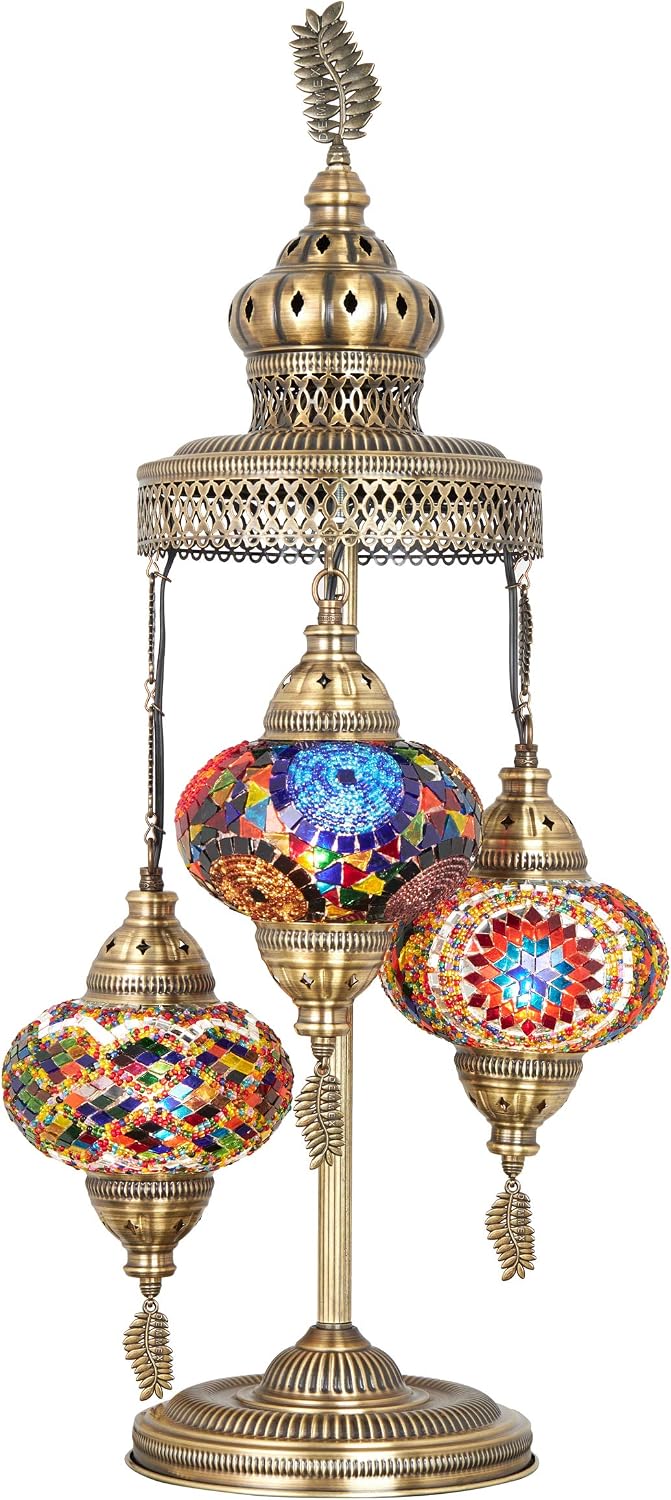
Imagine you’re browsing a Moroccan souk — the kind you’ve seen in a travel photo, long corridors hung with lanterns in amber, cobalt, and emerald. The ones that stop you aren’t the simple single-globe pendants. They’re the three-globe pieces: a central sphere flanked by two smaller ones, all suspended from a wrought-iron or brass armature, throwing overlapping halos of colored light across whitewashed walls. That shape has a name in the design trade — a fanous cluster (the Arabic word fanous simply means “lantern”) — and it’s the format that interior designers reach for when they need one fixture to do the work of five. This guide is for the buyer who already knows they want something like this, has a budget north of $100, and needs a clear decision framework before they commit. We’ll name the tradeoffs, show the math, and tell you which version of this lamp belongs where.
| EDITOR'S PICK[DEMMEX Turkish Moroccan Mosaic…](https://www.amazon.com/dp/B07CL83NF8?tag=greenflower20-20) | Mid-tier[DEMMEX 3-Globe Turkish Moroccan…](https://www.amazon.com/dp/B07CL83NF8?tag=greenflower20-20) | Budget pick[Marrakech Turkish Lamp 3 Globes…](https://www.amazon.com/dp/B0CJ4NYVZG?tag=greenflower20-20) | |
|---|---|---|---|
| Height | 37" | 21" | 23" |
| Material | Antique Brass | Antique Brass | Bronze |
| Globe size | 7" | — | — |
| Bulb included | — | — | ✓ |
| Price | $139.80 | $98.80 | $79.99 |
| See on Amazon → | See on Amazon → | See on Amazon → |
Why Three Globes and Not One
The honest answer is geometry. A single globe pendant — even a beautiful hand-blown beldi one (beldi means “traditional” or “of the land” in Darija, Moroccan Arabic, and refers to artisan goods made by inherited methods rather than factory process) — reads as an accent. It adds warmth. It does not anchor. The three-globe format changes the calculus because the armature itself becomes visible design: the iron or brass branching structure that holds the globes apart creates a silhouette you can read from across a room, even when the lamp is unlit.
Apartment Therapy’s editorial feature on statement pendants versus chandeliers makes this point precisely: a multi-globe fixture at the right scale “closes” a seating arrangement the way a rug does — it gives the eye a ceiling to return to. Architectural Digest’s 2024 lighting guide echoes this, noting that layered light sources with distinct color temperatures (warm ambient from the central globe, slightly cooler fill from the flanking ones) create the dimensional quality designers call “depth” in a room shot. A single pendant rarely achieves that without supplementary sconces.
The three-globe format also handles cultural register better than almost any other Moroccan form. It’s recognizable enough to signal the aesthetic — riad-inspired, Maghrebi, warm-maximalist — without requiring the rest of the room to perform. Elle Decor’s 2024 feature on Moroccan design in Western interiors specifically flags the multi-globe lantern as the piece most likely to work in a “one authentic, everything else neutral” strategy. That’s the practical payoff: you get the mood without the commitment to a full themed room.
The Anatomy of a Three-Globe Lamp: What You’re Actually Paying For
Before you evaluate price tiers, you need to know which components drive cost — and which ones drive durability. There are four:
1. The armature material. Iron is the entry point. It’s heavy, it holds shape, and it patinas predictably, but it will rust on an uncovered patio in a humid climate within one season unless it’s sealed or powder-coated. Brass (an alloy of copper and zinc) costs more to fabricate and is substantially more corrosion-resistant; the patina it develops over time is considered a feature, not a flaw, by collectors and designers. Copper armatures exist at the high end and are rarer — the color is warmer and more orange-red, the material is softer, and genuine copper filigree work commands a significant premium. If a listing says “brass-finish” without specifying the base metal, assume painted iron.
2. The glass type. Beldi glass — the hand-blown, slightly irregular Moroccan artisan glass — is identifiable by its air bubbles, thickness variations, and the pontil mark (a small rough circle left by the glassblower’s rod) on the base of each globe. The Spruce’s guide to identifying hand-blown glass notes that machine-made glass has perfectly uniform wall thickness and no surface texture variation; hand-blown glass does not. Colored beldi glass gets its pigment from metal oxides added to the molten batch — cobalt for blue, iron for green, manganese for amber — a process the Smithsonian Magazine’s 2022 feature on Fez artisans describes as largely unchanged since the medieval period. The practical difference: hand-blown globes scatter light organically. Machine-made globes produce an even, flat wash.
3. The joinery. How the globes attach to the armature matters for longevity. Look for wire-wrapped or soldered sockets rather than adhesive-set cups. In the $100–$200 range, you’ll find both; above $250, wire-wrapped is standard in reputable pieces. Globes that are adhesive-set will eventually separate, especially in temperature-swinging outdoor or patio environments.
4. The electrical fit. Most Moroccan-origin fixtures arrive wired for European current (220V, E27 socket standard) or are unwired entirely. For U.S. installation, you need either a fixture already converted for 110V/E26, or a rewire. Rewiring by a licensed electrician typically runs $75–$150 per fixture depending on your market — factor that into your total cost if sourcing direct from Marrakech ateliers or specialty importers.
By the Numbers: Price Tiers and What They Signal
| Price range | Armature | Glass | Typical source |
|---|---|---|---|
| $60–$100 | Painted iron | Machine-blown, dyed | Mass-market import (World Market, Amazon third-party) |
| $100–$200 | Iron or low-grade brass | Mixed — some hand-blown | Etsy makers, Anthropologie, Arhaus |
| $200–$450 | Brass or copper | Hand-blown beldi | Specialty importers, established Etsy ateliers |
| $450–$800+ | Solid brass / copper filigree | Artisan hand-blown, signed | Badia Design, Shades of Light, direct Marrakech commission |
At the $100–$200 threshold, the quality signal you’re shopping for is consistency of globe color (beldi glass has slight variation, but dramatic inconsistency in the same fixture suggests mixed-batch production) and visible armature construction (welded joins rather than crimped). Reviewers on Etsy and Apartment Therapy’s sourcing discussions consistently note that the most common failure mode in the $80–$150 range is globe-to-socket separation within 12–18 months of installation — a joinery problem, not a glass problem.
Outdoor vs. Indoor: This Tradeoff Is Not Optional
Three-globe Moroccan lamps are sold for both applications, and the spec difference is significant enough that using an indoor-spec fixture outdoors will cost you the piece inside two seasons.
For covered outdoor use (porch, pergola, lanai): brass or powder-coated iron armature is workable; raw iron is not. Globe seating needs to be fully soldered or wire-wrapped, not adhesive. IP44 rating or better on any enclosed electrical components. Reviewers at multiple specialty lighting retailers note that uncovered iron fixtures show visible rust bloom within one summer in humid climates even with seasonal sealing.
For exposed outdoor use (open patio, poolside): this is where most three-globe Moroccan lamps fail. The format is not designed for full weather exposure. If you are specifying for a hotel pool deck or open-air restaurant courtyard, the honest answer is a purpose-built outdoor fixture with a Moroccan aesthetic rather than an authentic Moroccan fixture pushed into an outdoor role. Badia Design and Shades of Light both carry outdoor-rated lantern forms; the three-globe cluster format in those outdoor lines uses sealed brass and UV-stable glass.
For indoor use: almost any well-constructed brass or iron three-globe piece will perform indefinitely. The considerations here are ceiling height (the fixture needs at minimum 7.5 feet of clearance to read as intended rather than as an obstacle) and room scale — a three-globe cluster with a 24-inch span is a dining room piece; a 14-inch span is a reading nook piece. Don’t scale down to save money and then wonder why the room doesn’t respond.
How to Vet a Listing Before You Commit
You’re looking at an Etsy listing or a specialty importer’s product page. Here’s the practitioner’s checklist:
Ask or look for: Globe diameter specified in inches or centimeters (not just “small/medium/large”). Armature material spelled out — “iron,” “brass,” “steel” — not just “metal.” Photo of the armature from below showing how globes attach. Whether the fixture ships wired (and for which voltage) or unwired. Country of fabrication — “made in Morocco” and “Moroccan-inspired” are not the same claim.
Red flags: Listings where every photo is styled and no detail shots exist. Globe colors that are too perfectly uniform. Price below $80 for a three-globe pendant claiming beldi glass and solid brass — the material cost alone doesn’t support it. Sellers who cannot answer a question about globe attachment method.
Green flags: Sellers who mention their maâlem (a maâlem is a master artisan who has completed the traditional apprenticeship system, roughly equivalent to a guild master) by name or region. Listings that specify Fez or Marrakech workshop origin. Photos showing the pontil mark or glass variation. Etsy sellers with longstanding review history specifically mentioning durability at the 1–2 year mark.
The Smithsonian’s reporting on Fez’s craft economy notes that the maâlem designation is meaningful — it represents a minimum of seven years of apprenticeship in the traditional msid (workshop) structure, and pieces traceable to a named maâlem carry both quality and provenance weight that matters for resale and for clients who ask about sourcing.
The Decision Rule
If you’re choosing between tiers right now, here’s the framework:
If this lamp is going in a primary social space — dining room, living room, boutique hotel lobby — and it’s the room’s anchor piece, spend the $200–$450. The visual payoff of genuine beldi glass in a properly scaled brass armature over a dining table is not replicable at $120. The math: a $350 fixture that holds for a decade and reads authentically in every photo of that room is a better cost-per-year than a $110 fixture you replace in three years and never quite believe in.
If this is a secondary space or a tryout purchase — a guest bedroom, a rental property, an outdoor covered porch where you’re testing the aesthetic — the $100–$180 range from a reputable Etsy maker is the right call. You’re buying the format and the mood, not the provenance.
If you’re specifying for hospitality at scale, the only honest path is direct sourcing from an importer like Badia Design or a direct Marrakech atelier with an English-speaking export contact, with a written spec for armature material, globe attachment method, voltage, and finish. Budget for a sample unit, electrical conversion, and a 10–15% breakage contingency on shipping. That’s not pessimistic — it’s what experienced specifiers build in, per standard practice in the direct-import sourcing community.
The three-globe Moroccan lamp is the one format in this category where the jump from $80 to $200 is consistently legible in the room. That’s rare enough to name it plainly.