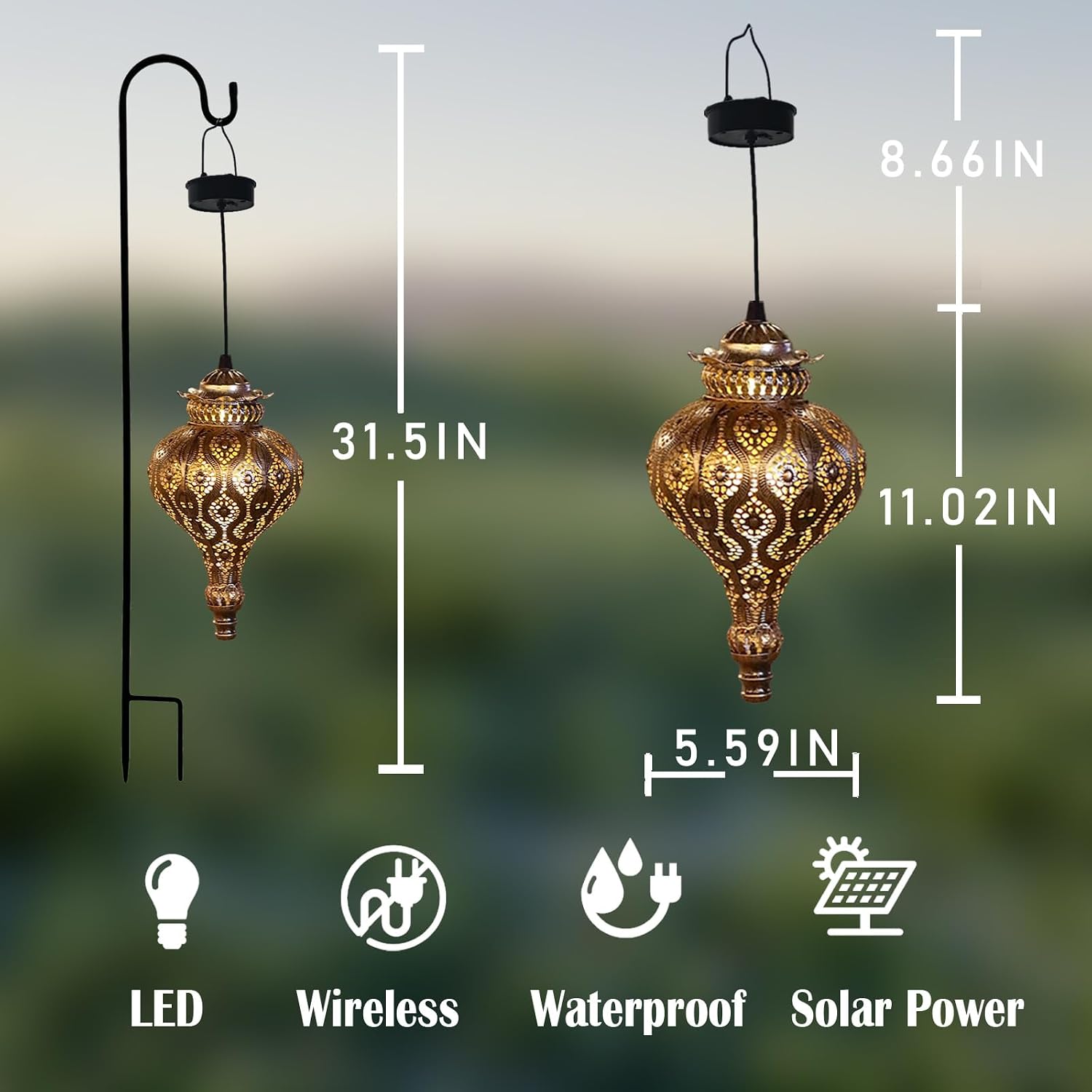
Picture this: you find a gorgeous Moroccan-style lantern at a market or online shop — intricate metalwork, colored glass panels, that warm geometric glow that makes every outdoor table look like it belongs in a Marrakech riad (a traditional Moroccan courtyard house). You hang it on the patio in May. By September, the metal has gone from antique brass to rust-orange, one glass panel has cracked in the heat, and the solar panel on top — the small photovoltaic cell that charges a battery during the day so the light runs at night — is yellowed and half-dead. That’s not a freak accident. It’s a pattern, and it’s almost entirely predictable if you know what to look for before you buy.
This guide is for the buyer who already understands that “Moroccan lantern” covers everything from a $30 machine-stamped import to a $600 hand-cut brass commission — and who now needs to know which of those options actually belongs outdoors and which one will cost you two replacements before the summer ends. We’ll go material by material, name the real failure points, and leave you with a clear decision rule.
The Three Things That Kill Outdoor Moroccan Lanterns (And How to Spot Them Before You Buy)
Every outdoor Moroccan lantern death story comes back to one of three culprits: metal corrosion, glass expansion-cracking, or solar component degradation. Understanding all three together is what separates an informed purchase from an expensive experiment.
Metal: The Brass vs. Iron vs. Aluminum Question
Authentic Moroccan lanterns in the artisan tradition are made from one of three metals — solid brass, copper, or iron — and each behaves completely differently outdoors.
Solid brass (an alloy of copper and zinc) is the benchmark. It oxidizes slowly into a greenish patina rather than rust, it holds its structural integrity in rain, and a good maâlem (the Arabic word for master craftsman, used specifically for skilled metalworkers in Morocco’s guild tradition) will tell you a well-made brass lantern can spend decades outdoors with minimal maintenance beyond occasional waxing. The problem: genuine solid brass is dense and expensive. Anything under $120 claiming “solid brass” outdoor construction deserves scrutiny. Per Apartment Therapy’s overview of outdoor lantern materials, the most reliable marker is weight — solid brass feels noticeably heavier than plated alternatives.
Wrought iron is the affordable workhorse, but it has a fundamental problem: it rusts. Iron lanterns are fine under a covered porch where rain contact is minimal, but even in humid climates without direct rainfall, condensation is enough to begin surface corrosion within one season. The paint or powder-coat finish buys time — typically 1–3 seasons depending on application quality — but once it chips, the rust spreads fast. House Beautiful’s patio lantern guide consistently flags powder-coat thickness as the decisive variable; thin coats (common in the $35–$70 price band) chip at corner edges first, exactly where the most water collects.
Aluminum is the unsung hero of the outdoor Moroccan lantern category, and it’s underrepresented in the artisan tier because it doesn’t have the cultural romance of brass. But for a $60–$130 solar lantern that genuinely needs to weather a season? Cast aluminum with an applied patina finish is a stronger long-term bet than iron with powder coat. It doesn’t rust — aluminum oxidizes, but that oxide layer is self-sealing. The tradeoff: it can’t be hand-cut or hand-pierced with the same fine detail as brass, so the filigree patterns tend to be less intricate at this price point.
The hybrid trap: Many mid-market solar Moroccan lanterns — the ones you’ll find in the $50–$120 range at mass retail — use iron frames with brass-colored electroplating. This looks convincing in photos but behaves like iron outdoors. The plating wears off at stress points within two seasons. If you’re buying online, look for the words “iron” or “steel” in the material spec even when the finish is described as “antique brass” or “bronze.” Those are finish descriptors, not metal descriptors.
Glass: Hand-Blown Beldi vs. Machine-Cut Panels
The colored glass in a Moroccan lantern is almost always one of two types. Beldi glass (the Moroccan Arabic term for “traditional” or “of the country”) is hand-blown glass, slightly irregular in thickness, with air bubbles and color variation that are features, not flaws. Machine-cut flat glass is uniform, optically clear, and significantly cheaper to produce.
Outdoors, the distinction matters because of thermal shock — the stress that happens when glass heats unevenly in direct sunlight and then cools suddenly from rain or temperature drop. Thicker, irregular beldi glass handles thermal cycling better than thin, uniform machine-cut panels, precisely because its inconsistent thickness distributes stress rather than concentrating it at one plane. The Spruce’s 2025 outdoor solar lighting overview notes that glass thickness under 3mm is a consistent failure point in outdoor lanterns exposed to direct afternoon sun.
Equally important: how the glass is set into the frame. Traditional Moroccan construction uses hand-bent metal channels that hold the glass with a small amount of movement tolerance. Mass-produced lanterns often use epoxy or silicone beads, which sound more weatherproof but actually create a rigid bond that transmits thermal stress directly into the glass edge — where it cracks.
If you’re buying from an Etsy maker or specialty importer, ask directly: “Is the glass set in channel or bonded?” Channel-set glass is the correct answer for anything going outdoors.
Solar Components: The Part Nobody Talks About Enough
Here’s the honest tradeoff in the solar Moroccan lantern category that most buying guides sidestep: the solar panel and battery assembly is industrial hardware grafted onto an artisanal object, and these two things have very different lifespans.
A well-made brass lantern, properly cared for, could last 20 years. The solar panel on top of it will typically degrade meaningfully in 3–5 years, and the lithium-ion battery inside will often lose significant capacity in 2–3 seasons of daily cycling. Per The Spruce’s solar light testing overview (2025), the most common failure mode in outdoor solar lanterns isn’t the panel — it’s the battery, which degrades faster in high-heat environments (think a south-facing patio in July) because heat accelerates lithium-ion degradation.
The decision frame here: Is the battery replaceable? In the artisan and mid-market tier ($80–$200), about half of solar lanterns have accessible battery compartments. In the lower tier ($25–$60), most are sealed units where battery failure means full replacement. If you’re investing in a quality brass or copper lantern, insist on a replaceable battery before you buy. It’s the difference between replacing a $6 AA rechargeable battery in year three versus replacing a $140 lantern.
By the Numbers
| Price tier | Typical frame metal | Expected outdoor lifespan | Battery replaceable? |
|---|---|---|---|
| $25–$60 | Iron / plated steel | 1–2 seasons | Rarely |
| $60–$130 | Iron or aluminum | 2–4 seasons | Sometimes |
| $130–$250 | Brass or cast aluminum | 5–10+ seasons | Usually |
| $300+ | Solid brass / copper | 10–20+ seasons (frame) | Yes (or hardwired) |
What “Outdoor Rated” Actually Means — and What It Doesn’t
The phrase “outdoor rated” on a product listing is doing very different work depending on where you see it. In the electrical and lighting industry, IP (Ingress Protection) ratings are standardized: IP44 means the fixture is protected from water splashing from any direction; IP65 means it’s protected from low-pressure water jets. These are relevant if your lantern has any wired or solar-electrical components.
Most Moroccan-style solar lanterns at retail don’t publish IP ratings. When Architectural Digest covered Moroccan-inspired outdoor spaces in 2024, the editors noted that the most durable patio lanterns in their sourcing were ones where the solar panel and battery housing were separately weatherproofed with a visible rubber gasket around the panel edge — a construction detail you can often spot in product photos if you look for it.
“Outdoor rated” with no IP number is marketing language. It typically means the seller believes the product will survive normal outdoor conditions, which is meaningfully different from “has been tested to a waterproofing standard.” For a covered porch or pergola in a mild climate, this is probably fine. For an open patio in the Pacific Northwest or a South Florida pool deck, you want a number.
Climate-Specific Decisions: Dry Heat, Humidity, and Salt Air Are Different Problems
The failure modes shift significantly by climate, and this is where a lot of buyers go wrong by applying general advice that doesn’t fit their specific situation.
Dry heat (Southwest U.S., southern Spain, North Africa itself): UV degradation of the solar panel is the primary risk, and glass cracking from thermal cycling is the secondary one. In these climates, beldi glass in a channel-set frame is a real advantage. Iron frames are actually somewhat better protected here because low humidity slows rust — but the UV cooks paint faster, so powder-coat quality still matters.
High humidity (Southeast U.S., coastal climates, Pacific Northwest): Rust is the dominant failure mode. In these climates, aluminum or solid brass is the correct answer even if it costs more upfront. Owners in coastal forums consistently report that iron lanterns — even well-sealed ones — begin showing rust within 18 months in high-humidity, salt-air environments. The math: a $90 aluminum lantern that lasts five seasons is less expensive than three $50 iron replacements over the same period.
Cold climates with freeze-thaw cycles: Glass-to-frame joints are the vulnerability. Water that gets into an epoxy-bonded joint expands when it freezes and pops the glass out. Channel-set glass, again, is more forgiving here. Battery performance also drops in cold — lithium-ion loses charge-holding capacity below about 32°F — so expect shorter run times in shoulder-season use.
The Decision Rule
You’re looking at a solar Moroccan lantern for your outdoor space. Here’s the filter:
If it’s a covered porch or pergola, mild climate, and you’re in the $40–$80 range: A well-reviewed iron lantern with thick powder coat will serve you 2–3 seasons, which is a reasonable return. Look for visible rubber-gasketed solar panels and confirm the return policy is 30+ days so you can test it through a rain event.
If it’s an open patio, humid or coastal climate, or you’re buying something you want to last: Spend up to the $100–$180 range for aluminum or solid brass construction. Confirm the battery is replaceable. If the seller can’t tell you whether the battery is accessible, that’s your answer — it isn’t.
If you’re sourcing for a hospitality project or buying at the $200+ artisan tier: The solar component is almost always the wrong choice at this level. Invest in authentic brass or copper construction — maâlem-made pieces with hand-pierced filigree are worth protecting — and either hardwire them to a low-voltage outdoor circuit or use a high-quality rechargeable insert candle for flameless ambiance. The lantern will outlast any battery assembly by a decade.
The authentic Moroccan lantern tradition — the kind documented through guild records in Fez and Marrakech, the kind that House Beautiful and Architectural Digest consistently return to as the benchmark for this aesthetic — was built for interior courtyards and exterior walls in a North African climate. Those pieces were made to last. The solar panel on top is a modern convenience layer, not a permanent part of the object. Treat it accordingly, and you’ll make the right call at every price point.