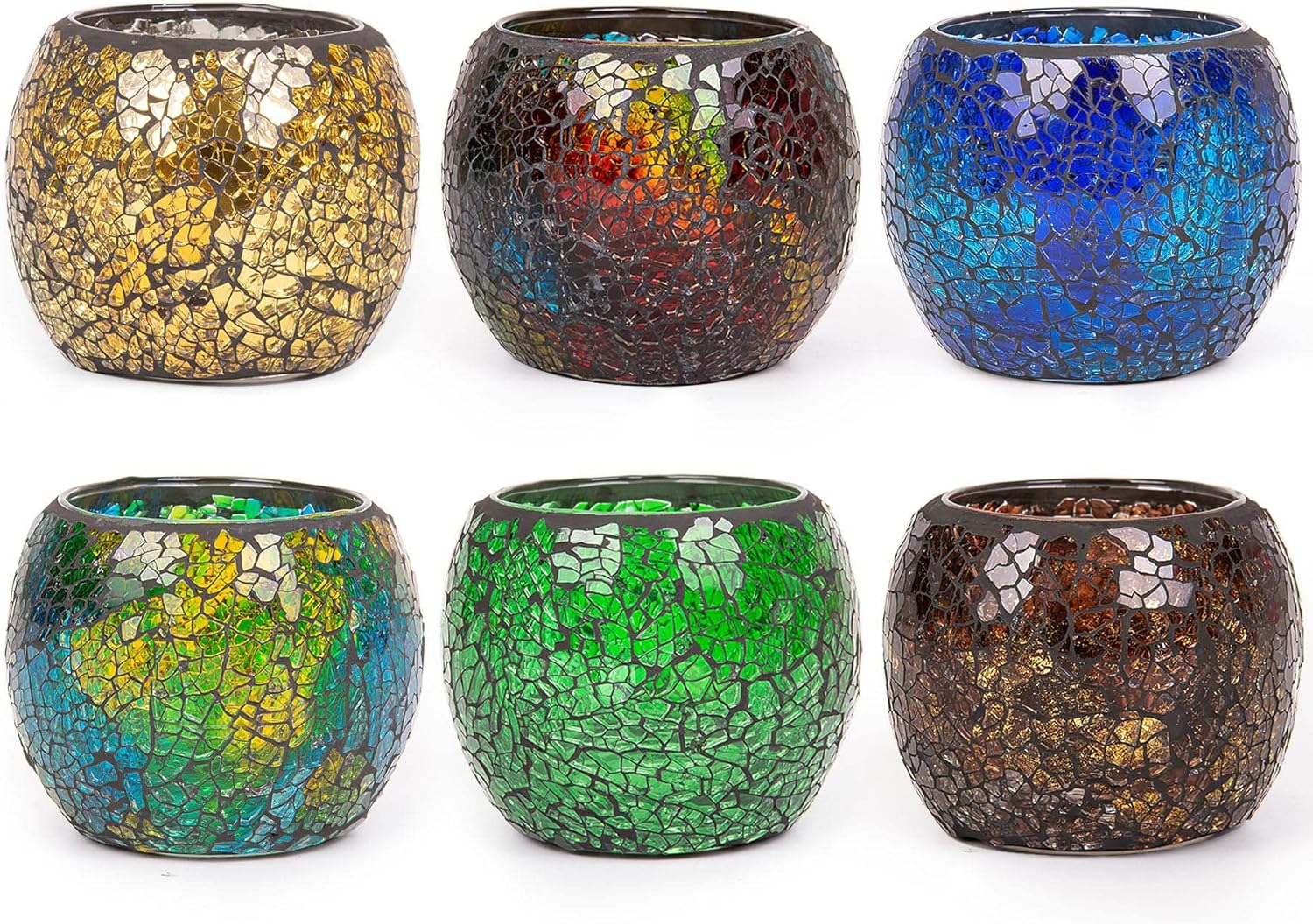
Picture this: you’ve just bought three mosaic glass tealight holders — small vessels wrapped in hand-cut colored glass tiles that catch candlelight and throw jeweled reflections across the table. They looked incredible in the product photos. But when you arrange them on your dining table, something feels off. They don’t read as a considered vignette; they read as a souvenir display. The colors compete. The scale is wrong. The whole thing looks like a gift shop next to a riad lobby.
That gap — between gorgeous individual objects and a cohesive composed scene — is exactly what this guide addresses. Mosaic glass tealight holders are small objects with outsized visual power, and they reward a practitioner’s eye: someone who already understands that “more Moroccan” isn’t the goal, but that the right edit of authentic craft objects, scaled and colored correctly, creates something that feels genuinely transportive. If you’re sourcing for a client, staging a boutique hospitality space, or curating your own dining room with seriousness, this is the cheat sheet.
| EDITOR'S PICK[Rancco Glass Votive Candle Hold…](https://www.amazon.com/dp/B09T6RXQGN?tag=greenflower20-20) | Mid-tier[Rancco Tea Light Candle Holder…](https://www.amazon.com/dp/B09T6RXQGN?tag=greenflower20-20) | Budget pick[OwnMy Set of 3 Blue Mosaic Glas…](https://www.amazon.com/dp/B09Q5YGNJB?tag=greenflower20-20) | |
|---|---|---|---|
| Qty per Set | 6 | 3 | 3 |
| Color | — | — | Blue |
| Use for | — | — | Tealight, Pillar |
| Handmade | ✓ | ✓ | — |
| Shape | — | Jar | Round Bowl |
| Price | $30.99 | $21.39 | $17.99 |
| See on Amazon → | See on Amazon → | See on Amazon → |
What Separates a Craft Object from a Trinket (Before You Buy)
The single most useful filter at this market tier isn’t price — it’s construction method, and the signals are readable in any good product listing.
Hand-cut mosaic versus machine-stamped tiles. Authentic Moroccan mosaic glass — made in workshops in Fez, Marrakech, and Tetouan — uses hand-cut zellige-adjacent glass tiles (zellige, pronounced zeh-LEEJ, is the traditional Moroccan art of hand-chiseling ceramic or glass fragments into geometric mosaics). Each piece is slightly irregular. Grout lines vary by a millimeter or two. Colors within a single tile shift because the glass itself is uneven in thickness — a hallmark of beldi (BEL-dee) technique, meaning “traditional” or “of the country.” Machine-stamped tiles are perfectly uniform: identical size, identical edge, flat color. Under candlelight, they read as flat. Hand-cut tiles fracture and redirect light in multiple directions; that’s the whole point.
The metal base tells you everything. Authentic workshop production uses brass or copper for the filigree collar and base ring. Both develop a patina over time — brass toward a warm golden-green, copper toward russet — which integrates beautifully with aged interiors. Iron is cheaper, takes electroplated finishes that rub off within a season, and in humid outdoor settings will begin surface rust within months. Reviewers on Etsy specialty import listings consistently flag iron-framed pieces as the ones that “looked great in photos but aged badly within a year,” per aggregated seller review analysis on several Moroccan craft Etsy storefronts reviewed in 2025.
Color saturation versus color complexity. Mass-produced mosaic glass tends toward high-saturation single colors — a flat cobalt, a screaming red, a saturated amber. Authentic hand-blown beldi glass has internal variation: a green tile reads as olive in one angle and forest in another. When you’re evaluating a listing, zoom into the tile surface. If every piece of the same color is identical in tone, it’s machine-made glass. If there’s variation within tiles of the same hue, you’re looking at something made by a person, not a mold.
Elle Decor’s 2024 feature on Moroccan import distinctions notes that the surest provenance signal in mosaic glass is precisely this internal color variation — “the sign of glass blown and cooled without industrial temperature control, which produces the depth that makes candlelight so dynamic.”
The Styling Math: Scale, Count, and Color Editing
Here’s where most intermediate buyers make the error. They select good objects — genuinely hand-cut, brass-framed, beldi glass — and then overload the table. The result is visually busy, not beautiful. The gift-shop feeling isn’t about quality; it’s about density and color count.
By the Numbers: The Moroccan Candlescape Formula
| Variable | Gift-shop mistake | Practitioner edit |
|---|---|---|
| Color families on one surface | 4–6 competing hues | 2–3 related hues |
| Holder count on a 6-seat table | 8–12 scattered | 3–5 grouped |
| Height variation | All same height | 3 distinct heights minimum |
| Negative space | Filled | 40% of surface left open |
Architectural Digest’s 2025 guide to candlelight tablescapes articulates the rule of odd numbers as essentially non-negotiable for vignette composition: three holders read as a considered cluster; two read as a pair (symmetrical, formal); four read as a grid (rigid). If you’re working a rectangular dining table, a cluster of five — two tall, two medium, one low — at the center third of the table, with the remaining two-thirds clear, outperforms twelve holders distributed evenly every time.
The color editing rule. Pick one dominant hue, one accent, and let the brass or copper metalwork be the neutral that holds it together. Amber and smoke (a dark charcoal-toned glass) with brass filigree is the most forgiving palette: the amber reads warm and Maghrebi, the smoke adds depth without competing, and the brass unifies. If a client or your own room has cooler tones — blue-gray walls, concrete, linen — cobalt and clear (untinted beldi glass is still beautiful; its texture catches light without adding color) with brass works. What doesn’t work: amber, cobalt, green, and red on the same surface. That’s the gift shop.
House Beautiful’s 2025 maximalist tablescape feature is instructive here even for smaller-scale work: editors specifically call out “the edit within the abundance” as the skill — knowing which pieces to pull back, not how many to add.
Sourcing Tiers: Where to Buy and What You’re Actually Getting
$25–$60 tier: World Market, Etsy mass-market shops, HomeGoods. At this price, you can find genuinely decent mosaic tealight holders if you apply the tile-variation test described above. World Market sources some pieces from Moroccan production workshops, though the brass-to-iron ratio at this price leans iron. For indoor use on a dining table — no humidity, no temperature swings — iron-framed pieces last fine. For outdoor patios, don’t bother; you’ll replace them in a season. At this tier, buy for color and tile quality; accept that the metal frame is functional but not heirloom.
$80–$180 tier: Etsy specialty importers, Anthropologie, boutique home stores. This is where the sourcing story starts to matter and to be verifiable. Look for Etsy sellers who name specific cities of origin (Fez is the historic center of zellige craft; Marrakech workshops are more export-oriented and vary more in consistency; Tetouan has a strong tradition of colored glass work per Smithsonian Magazine’s 2023 craft-tradition feature on Moroccan artisan regions). Sellers in this tier who provide workshop names or maâlem (maa-LEM — master artisan, a formal designation in the Moroccan craft guild system) credits are the ones worth the premium. The brass-frame likelihood climbs sharply here; copper-frame pieces appear at the higher end of this range.
$300+ tier: specialty importers, direct Marrakech atelier commissions, Badia Design. At this tier you’re buying provenance documentation and collector-grade construction. Hand-cut tiles here are often fouguara (intricate star-pattern cuts) rather than simple geometric squares — a technique that requires significantly more skilled labor and produces a much more complex light refraction pattern. If you’re specifying for a boutique hospitality client, this tier is where you should be working; the pieces hold visual authority at architectural scale and survive the scrutiny of repeat guest visits. Badia Design, a Los Angeles-based Moroccan craft importer, is one of the few domestic sources that provides workshop provenance documentation for pieces in this range.
The Spruce’s 2025 guide to candle holder selection at different price points makes the useful point that “the question isn’t whether to spend more, but whether the use case justifies durability and provenance documentation” — outdoor terraces, commercial settings, and display-level residential installations all justify the upper tier; a bedside styling moment does not.
The Outdoor Question: What Actually Survives a Season
If you’re styling a patio, a pool deck, or an outdoor entertaining space — a genuinely common use case for Moroccan lanterns and tealight holders — the material hierarchy shifts.
Brass outperforms copper outdoors because its zinc content makes it more corrosion-resistant in humid air. Both outperform iron significantly. For coastal or poolside environments, owners of brass-framed pieces consistently report surface-appropriate patina without structural degradation after two to three seasons; iron-framed pieces from the same context show rust bleed into grout lines within the first year in aggregated buyer review data from several Moroccan home goods retailers.
The glass tiles themselves are not the fragile element outdoors — properly set mosaic glass is genuinely durable. The failure points are the grout (lower-quality pieces use sanded grout that absorbs moisture and cracks through freeze-thaw cycles in northern climates; look for epoxy grout on pieces marketed for outdoor use) and the metal frame’s finish integrity.
Apartment Therapy’s 2024 tablescape-without-theming guide makes a point that applies directly to outdoor Moroccan styling: “One authentic object read correctly by the space — scale, material, placement — beats six objects that say the same thing louder.” For a patio context, that means one or three brass-framed mosaic holders as the candlescape center, not a ring of twelve around the perimeter.
The Decision Rule
If your context is indoor dining, single-room, $25–$150 budget: apply the tile-variation test, buy in the amber-and-smoke or cobalt-and-clear palette, group in odd numbers with height variation, and leave 40% of your surface clear. Iron frame is acceptable indoors at this budget. Don’t buy more than five holders for a six-seat table.
If your context is outdoor or high-humidity: brass frame is non-negotiable. Budget accordingly — this likely moves you to the $80–$180 tier minimum for genuine brass construction. Check for epoxy grout on outdoor-marketed pieces.
If you’re specifying for a hospitality client and a single table or bar vignette needs to hold up to daily use and guest photography: go to the $300+ tier, request workshop provenance, and treat the mosaic tealight cluster as the table’s one statement rather than one element among many.
The gift shop feeling comes from maximalism without editing and from pieces that don’t hold up to scrutiny. The fix isn’t restraint for its own sake — Moroccan aesthetic is legitimately rich and layered — it’s knowing which objects earn their place, and letting the candlelight do the rest.