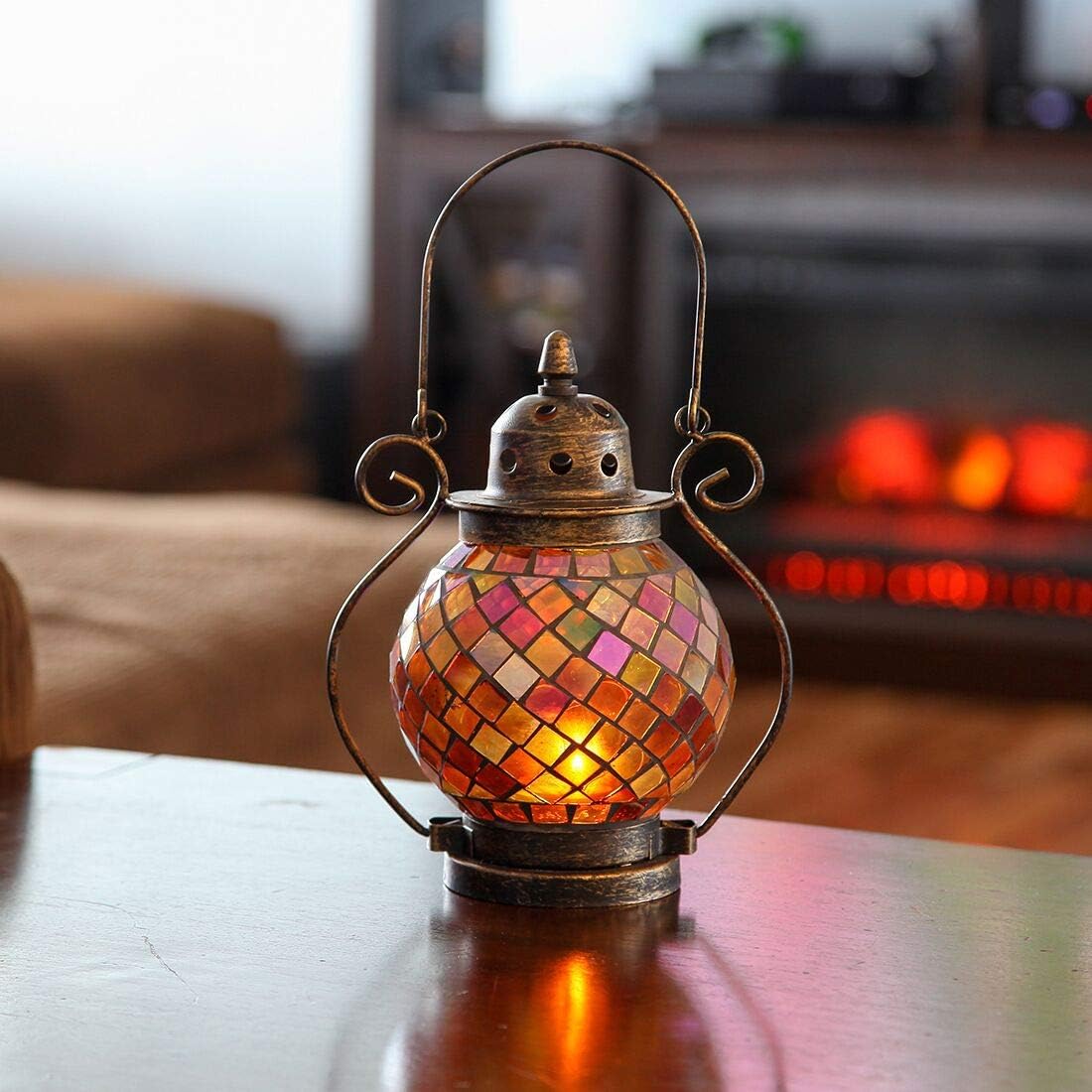
Picture this: you’re standing in a World Market aisle, or scrolling an Etsy shop from a Marrakech maker at 11 p.m., and you’re holding two lanterns in your mental cart. One is a sleek all-brass thing. The other is this hybrid — a dark iron frame packed with irregular wedges of colored glass that glow amber and cobalt when the light hits them. You’re drawn to the hybrid but you’re not sure if it’s actually Moroccan, if the glass will hold up outside, or whether it reads as artisan-quality or just… department store. That hesitation is exactly what this guide is here to resolve.
The lantern you’re looking at belongs to a category that the trade informally calls the wrought iron and mosaic glass hybrid — a form that pairs a hand-forged or cast iron frame (the structural skeleton) with hand-cut or hand-pressed colored glass set in the panels. It’s distinct from a pure brass fanous (the traditional pierced-metal lantern of Egyptian and Levantine craft) and from a zellige mosaic fixture (those are flat-surface tile installations, not glass-panel lanterns). The hybrid sits at the intersection of two traditions, which is both its commercial strength and the source of most of the confusion buyers bring to it.
| EDITOR'S PICKLily's Home Decorative Candle L… | Mid-tier[Vintage Large Size Decorative R…](https://www.amazon.com/dp/B0BL7BP5DC?tag=greenflower20-20) | Budget pick6.7'' Moroccan Lanterns Decorat… | |
|---|---|---|---|
| Material | Wrought Iron, Mosaic Glass | Metal | Metal, Glass |
| Dimensions | — | 12.8'' | 6.7'' |
| Use | Indoor/Outdoor | Hanging & Tabletop | Hanging & Tabletop |
| Candle Included | ✗ | — | — |
| Color | Orange and Gold | — | Gold |
| Price | $29.95 | $15.29 | $9.99 |
| See on Amazon → | See on Amazon → | See on Amazon → |
What You’re Actually Looking At: Form, Materials, and Where Authenticity Lives
The wrought iron frame is the first decision axis. Proper wrought iron — meaning iron that has been heated and hand-hammered, not poured into a mold — shows slight irregularity in bar width, visible hammer marks on close inspection, and a surface texture that takes rust-inhibiting patinas differently than smooth cast iron. In the $80–$200 Etsy and Anthropologie tier, you’ll see both genuine hand-forged frames from Moroccan workshops and cast iron frames dressed up with a matte black finish to approximate the look. The practical difference: hand-forged frames have better long-term corrosion resistance because the hammering densifies the iron grain, while cast iron is more porous and shows rust faster in humid or outdoor conditions. Apartment Therapy’s outdoor lantern durability guide specifically flags cast iron’s vulnerability to pitting at the joints where glass panels seat, which is the highest-moisture zone on any lantern.
The glass is the second axis — and the more culturally loaded one. Beldi glass (beldi literally means “traditional” or “of the country” in Darija, Moroccan Arabic) is mouth-blown glass that gets its characteristic surface irregularities, bubbles, and color variation from the blowing process itself. Cut into the irregular geometric wedges used in mosaic lanterns, it produces a light scatter that machine-rolled glass simply cannot replicate — the illuminated effect is less uniform, more alive. The Smithsonian Magazine’s reporting on Fez craft guilds notes that beldi glass production remains centered in workshops in the Fez and Marrakech medinas, where the recipe and blowing technique pass from maâlem (master craftsman) to apprentice within family lineages. Machine-pressed glass, by contrast, is flat-surfaced and consistent in thickness, which means it fills panel spaces cleanly but produces a flatter, more commercial glow.
When you’re evaluating a specific piece, here’s the fast provenance read: tilt the lantern so light rakes across the glass surface. Genuine beldi glass shows micro-undulations and occasional elongated bubbles. Machine glass is optically flat. This matters at the $150+ price point; below $80, you’re almost certainly looking at machine glass, and that’s fine as long as you know it.
The Price-Tier Breakdown: What the Math Actually Tells You
Here’s where being a practitioner pays off — you can do the cost-allocation math that most buyers skip.
By the numbers (May 2026 market conditions):
- $25–$60 tier: cast iron or powder-coated steel frame; machine-pressed glass; factory production, often Vietnam or China sourcing with Moroccan design DNA
- $80–$200 tier: hand-forged iron or quality cast iron; mixed glass (some beldi, some machine); Moroccan workshop production or supervised export
- $300–$600 tier: verified hand-forged iron; predominantly or entirely beldi glass; documented maâlem workshop; often available in custom colorways
- $600–$800+ tier: bespoke commission, architectural scale, custom glass color specification, documented atelier provenance
The reason the hybrid form dominates the $80–$200 tier is economic, not aesthetic. Brass is expensive and requires skilled metalwork at every joint; a pure brass lantern in this price range cuts corners on gauge or joinery. Iron is cheaper to forge, structurally robust, and provides a visual contrast that makes the glass pop harder. Elle Decor’s feature on maximalist metalwork notes that the dark iron / colored glass pairing has become a signature look in both Moroccan-inspired residential interiors and boutique hospitality contexts because the contrast reads as intentional rather than precious — it doesn’t require a fully themed room to carry its weight.
The trap in the $80–$200 tier is paying artisan prices for factory product. The tell: uniform panel spacing, perfectly consistent glass wedge sizing, and a frame finish that looks sprayed rather than worked. Authentic workshop production shows slight variation in panel geometry — the iron bars aren’t all exactly the same cross-section, and the glass pieces are hand-cut rather than machine-diced.
Indoor vs. Outdoor: The Decision That Changes Everything
This is the question where most intermediate buyers make their first expensive mistake. The short version: wrought iron and mosaic glass hybrids can work outdoors, but the conditions that kill them are specific, and they’re worth naming explicitly.
What degrades first: The iron-to-glass junction. Most lanterns in this form use a combination of lead came (the flexible metal channel that holds glass in stained-glass work), epoxy, or silicone to seat the glass wedges in the iron frame. In covered outdoor conditions — a patio with an overhang, a pergola, a sheltered courtyard — the junction holds for several seasons. In exposed outdoor conditions with direct rain and thermal cycling (hot days, cold nights), the sealant degrades, glass shifts, and the iron oxidizes fastest at the joint line. Apartment Therapy’s outdoor lantern guide specifically flags this junction failure as the primary reason mosaic lanterns get returned or replaced after one harsh season.
The practical decision rule: If the lantern is hanging under cover and you can bring it inside during winter, you’re fine with any tier above $80. If it’s fully exposed — poolside, open patio, rooftop — you need either a lantern with epoxy-encapsulated glass joints (ask the seller explicitly) or you need to treat it as a one-to-three season piece and price accordingly. The $25–$60 tier is actually more forgiving outdoors in some ways, because you’re not heartbroken when you replace it.
For boutique hospitality specifiers working on outdoor dining or pool deck installations: the Architectural Digest styling guide notes that the design language of Moroccan lanterns in hospitality contexts works best when you commit to a purpose-built outdoor specification rather than adapting indoor fixtures. Several specialty importers including Badia Design offer weather-treated frames on custom orders; it’s worth the conversation before you specify six pendant positions over an open-air terrace.
How to Shop the Hybrid at Each Tier
The $25–$60 pick (World Market, Etsy entry-level): You want this one for your dining nook mantelpiece or a clustered tabletop vignette — not your patio. Look for a frame where the black finish has some texture variation, not a perfectly uniform spray coat. The glass color palette matters more than the glass quality at this price: deep amber and cobalt read most authentic; bright primary colors skew commercial.
The $80–$200 pick (Etsy artisan makers, Anthropologie): This is where the hybrid form earns its reputation. Prioritize sellers who photograph their frames in natural light close enough to show the ironwork surface. Ask directly: hand-forged or cast? Beldi glass or machine? Reputable Moroccan workshop sellers answer these questions without hesitation. House Beautiful’s zellige tile overview notes that buyers who ask provenance questions are almost always served better by sellers who volunteer the information rather than deflecting. The same pattern holds in lanterns.
The $300–$600 pick (specialty importers, direct atelier): At this tier, you’re paying for documented maâlem provenance and color-specific beldi glass. The customization value is real — you can specify the glass palette to match an existing room palette in a way that off-the-shelf pieces don’t accommodate. Shades of Light and direct Marrakech-sourced ateliers are worth the extra communication overhead for a statement dining pendant or a pair of flanking entryway lanterns. Verify the electrical conversion specification before ordering if you’re in North America; most Moroccan workshop pieces are wired for European 220V and require either an external converter or rewiring on import.
The boutique hospitality spec (four-figure commissions): At architectural scale — a linear array of eight pendants over a hotel lobby bar, or a custom mosaic panel with integrated lighting — the hybrid form’s iron skeleton becomes a structural asset. The frame can be engineered for ceiling canopy mounting in ways that pure glass fixtures can’t. Get documented atelier references and shipping insurance for pieces over $500; breakage on import is real, and per Smithsonian Magazine’s reporting on Fez export workshops, the best ateliers pack individual glass panels separately and offer documented replacement-panel fulfillment.
The Decision Frame: If X, Then Y
Here’s the clean version for anyone mid-decision:
If your install is covered outdoor or indoor and budget is under $100: Buy on glass color and frame texture alone. Machine glass is fine. Cast iron is fine. Prioritize visual impact per dollar.
If your install is indoor and you want the piece to anchor the room for 5+ years: Spend to the $150–$300 range, verify beldi glass, ask about hand-forging. The glow quality from authentic beldi glass in a dark room is a perceptible step up that owners consistently report noticing years after purchase.
If your install is exposed outdoor: Either treat it as a seasonal piece at the $25–$60 tier, or source a purpose-treated frame from a specialty importer. Do not spend $200+ on a mosaic lantern for an uncovered patio without confirming epoxy-sealed glass joints.
If you’re specifying for hospitality or a collector-grade interior: Commission at the $300+ tier, verify maâlem documentation, and budget for electrical conversion and shipping insurance. The hybrid form reads as intentional rather than imitative at this tier — which is exactly the quality that separates a room that feels traveled-in from one that feels themed.
The wrought iron and mosaic glass lantern is not a compromise form. It’s a distinct tradition that draws on Moroccan metalwork and beldi glass-blowing in a configuration that happens to travel well across price tiers — and across the line between interior and exterior, authentic and accessible, when you know which questions to ask.