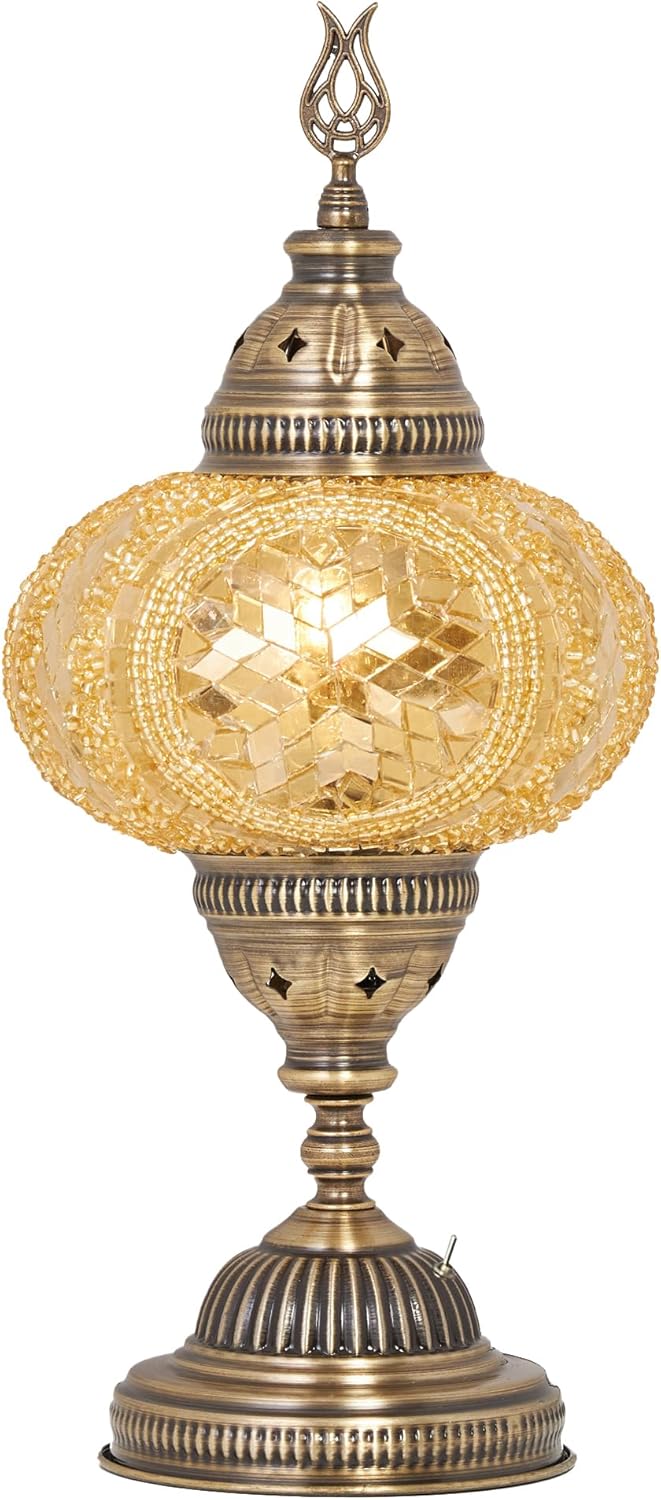
Imagine you’ve just rented a new apartment with a strict no-drilling policy, or you’re mid-renovation with wiring that won’t be sorted for another six weeks — but you need the dining area to look finished for a dinner party on Saturday. This is exactly where cordless Moroccan table lamps earn their keep. A Moroccan table lamp, for the uninitiated, is a small to medium lantern-style fixture — typically a pierced metal body (brass, copper, or iron) holding a colored or clear glass insert — that traditionally hangs or sits on a surface and casts a warm, patterned light across walls and ceilings. The cordless version swaps the hardwired socket for a rechargeable LED module or standard batteries, meaning zero electrical work, no cord management, and total portability. This guide will walk you through how to evaluate them honestly, what distinguishes authentic craftsmanship from a factory shortcut, and which format makes sense for your specific use case — rental shelf, outdoor terrace, or commercial vignette.
| EDITOR'S PICK[DEMMEX Battery-Operated Turkish](https://www.amazon.com/dp/B07S3K4DC4?tag=greenflower20-20)… | Mid-tier[JHY DESIGN Moroccan Style Vinta](https://www.amazon.com/dp/B0896SPPV7?tag=greenflower20-20)… | Budget pick[HAIDOLIANG Turkish Table lamp (](https://www.amazon.com/dp/B0C2XYLGQX?tag=greenflower20-20)… | |
|---|---|---|---|
| Height | 12" | 11.5" | 5.2" |
| Material | Stained glass | Metal | Mosaic glass |
| Battery type | — | — | USB power |
| Included bulb | — | Edison bulb | — |
| Base material | — | — | Wooden base |
| Price | $39.80 | $29.99 | $18.99 |
| See on Amazon → | See on Amazon → | See on Amazon → |
Why Cordless Is a Legitimate Design Strategy, Not a Compromise
There’s a version of this conversation where cordless gets treated as the second-best option you choose when the real thing isn’t possible. That framing is increasingly outdated. Apartment Therapy’s 2025 roundup of battery-operated lamps for every room notes that rechargeable LED technology has closed the warmth gap dramatically — modern units routinely hit 2,200–2,700K color temperature, which is the amber range that makes Moroccan pierced metalwork look the way it’s supposed to: golden, textured, alive.
The more relevant question isn’t “is cordless as good as hardwired?” It’s “does the lamp fixture itself have the craftsmanship that justifies putting it anywhere in your space?” A poorly cast iron body with stamped (rather than hand-pierced) cutouts will look flat whether it’s plugged in or battery-powered. The light source is almost incidental compared to the quality of the vessel it’s sitting inside.
Architectural Digest’s 2024 feature on layering Moroccan lighting in modern interiors makes a point worth internalizing: a single well-chosen surface lantern at seated eye level — roughly 18–24 inches tall — does more atmospheric work than three mediocre pendants overhead, because it creates the low, intimate light pool that defines riad (a traditional Moroccan courtyard house, typically featuring a central garden and rooms arranged around it) hospitality aesthetics. Cordless table lamps are uniquely suited to this job because you can position them exactly where the glow needs to land, without being tethered to an outlet.
The Craft Variables That Actually Affect Cordless Performance
Here’s where practitioners need to think differently than casual shoppers. When you’re evaluating a cordless Moroccan lamp, there are two overlapping quality dimensions: the fixture’s craft quality and the cordless module’s functional quality. Conflating them is how you end up with a beautiful lamp that runs out of charge in three hours, or a technically solid LED unit inside a body that looks like it was made in a day.
On the fixture side, the critical markers are:
-
Piercing technique. Hand-pierced metalwork (done by a maâlem, the Moroccan term for a master craftsperson who has completed a formal apprenticeship, often spanning a decade or more) produces slightly irregular, organic cutout patterns. Machine-stamped cutouts are perfectly uniform and shallower — they catch light differently, producing a harder-edged projection rather than the soft, slightly blurred star-and-polygon patterns that define authentic Moroccan lantern aesthetics. Smithsonian Magazine’s 2023 piece on Moroccan metalwork traces the maâlem tradition specifically to the Fez medina workshops, where the piercing is done freehand from memory, not traced from a template.
-
Metal type. Brass (an alloy of copper and zinc) will patina slowly to a warmer, deeper gold. Copper patinas faster and runs cooler-toned (more rose-amber). Iron is the budget workhorse — heavier, more rust-prone outdoors, but fine inside. For cordless lamps that will live outdoors on a terrace or near a pool, brass or copper with a lacquer seal is the defensible spec; iron needs monitoring in humid climates.
-
Glass insert quality. Beldi glass — hand-blown recycled glass originating in Morocco, characterized by slight bubbles, uneven thickness, and a soft greenish or amber tint — diffuses light in a way that machine-made glass simply doesn’t replicate. If the product listing doesn’t specify beldi or hand-blown glass, assume it’s machine-made. That’s not disqualifying, but it changes the light output: cleaner, harder, less characterful.
On the cordless module side:
-
Rechargeable USB-C vs. AA battery. Rechargeable units are the practical choice for any lamp that will be used regularly. AA-battery units are fine for occasional-use pieces or outdoor contexts where charging access is inconvenient. The Spruce’s 2025 buying guide on battery-powered table lamps recommends looking for a minimum 8-hour runtime on a single charge for dining and entertaining use — shorter runtimes create the annoying mid-dinner charge-scramble.
-
Dimmer compatibility. Quality cordless modules now include a tap-to-dim or stepless dimmer function. This matters enormously for Moroccan lanterns because the pierced-shadow effect is most dramatic at lower brightness settings, not full blast. A lamp without dimming capability is being used at roughly 20% of its atmospheric potential.
-
IP rating for outdoor use. If the lamp is going on a patio or pool deck, look for at minimum IPX4 (splash-resistant) on the LED module. The metal body may be fine in light rain; the electronics are the vulnerability.
By the Numbers
| Use Case | Recommended Runtime | Ideal Color Temp | Price Range (fixture + module) |
|---|---|---|---|
| Indoor dining / bedroom | 8–12 hrs per charge | 2,200–2,700K | $60–$180 |
| Covered outdoor terrace | 8+ hrs, IPX4 module | 2,400–2,700K | $80–$220 |
| Commercial vignette / boutique hotel | 12+ hrs, IPX5+, dimmable | 2,200K | $180–$500+ |
Shopping the Tiers: Where Craftsmanship and Cordless Actually Overlap
The honest tension in this category is that most mass-market cordless Moroccan lamps are sold as a complete unit — fixture and light source together — optimized for manufacturing ease rather than either craft quality or electrical performance. The better strategy at the intermediate level is often to source these components separately or to identify the handful of makers who have genuinely solved both problems.
Entry tier ($25–$80): World Market and similar mass retailers carry iron-body pierced lanterns that accept standard candle-base LED bulbs. You can convert these to cordless by dropping in a battery-operated flickering LED candle module — widely available through major online retailers. The fixture quality at this price is stamped-iron, not hand-pierced, but the form factor is recognizably Moroccan and the scale (typically 8–14 inches tall) works well for shelf and side-table vignettes. Elle Decor’s 2025 riad-style lighting feature specifically calls out the power of grouping three mismatched lanterns at different heights as a way to create depth without investing in statement-scale pieces.
Mid-market ($80–$200): This is where the cordless category gets genuinely interesting. Etsy makers sourcing directly from Fez or Marrakech ateliers — workshops where a named maâlem oversees production — are increasingly offering hand-pierced brass or copper lanterns pre-fitted with rechargeable LED modules. The craftsmanship markers (irregular cutouts, beldi glass inserts, visible hand-finishing on the seams) are present, and the light source is purpose-matched. When evaluating these, ask the seller specifically: Is the piercing hand-done or CNC-cut? What is the LED module brand and rated runtime? Reputable Etsy sellers in this tier answer these questions directly; vague responses are a provenance red flag.
Anthropologie’s house-brand lanterns occupy a similar price band and are worth considering for their finish quality and consistent LED integration, though the provenance story is less specific than direct-from-atelier sourcing.
Upper-mid and specialist tier ($200–$500+): Specialty importers including Badia Design carry hand-cut mosaic (zellige — the traditional Moroccan tilework made from hand-chiseled fired-clay tiles, distinct from ceramic imitations) lamp bases and lantern bodies that can be adapted for cordless use. At this tier, you’re typically sourcing the fixture and the cordless module separately and having a local electrician or lighting specialist do the conversion. The investment is justified when the piece is a room anchor — something that will be in place for years, not a seasonal refresh.
The If-Then Decision Framework
If you’re a renter who needs a no-commitment, movable light source for a dining nook or bedroom corner, go mid-market Etsy with a built-in rechargeable module — one well-chosen 12–16-inch hand-pierced brass lantern at table height will do more than a cluster of entry-level pieces, and you can take it with you when you move.
If you’re a renovator bridging a gap while electrical work is underway, entry-tier iron lanterns with drop-in LED candle modules are the right call — low spend, functional for months, easily repurposed to outdoor use once the hardwired fixtures are in.
If you’re specifying for a commercial space — a boutique hotel room, a restaurant private dining area, a rental property you’re styling for short-term let — the calculation changes. Runtime, durability, and consistency across multiple units matter more than any single piece’s uniqueness. In this context, either source a batch from a single atelier (consistency of hand-finish across units is genuinely hard to achieve and worth paying for) or specify a single high-craft statement piece per room and fill supporting positions with simpler, more durable units.
The one rule that holds across every tier: a dimmer is non-negotiable. The shadow play that makes Moroccan pierced metalwork worth buying at any price — those soft polygons and stars moving slowly across a white wall — only reveals itself at 30–50% brightness. A cordless lamp without dimming is a lamp you’re using wrong, regardless of what you paid for it.