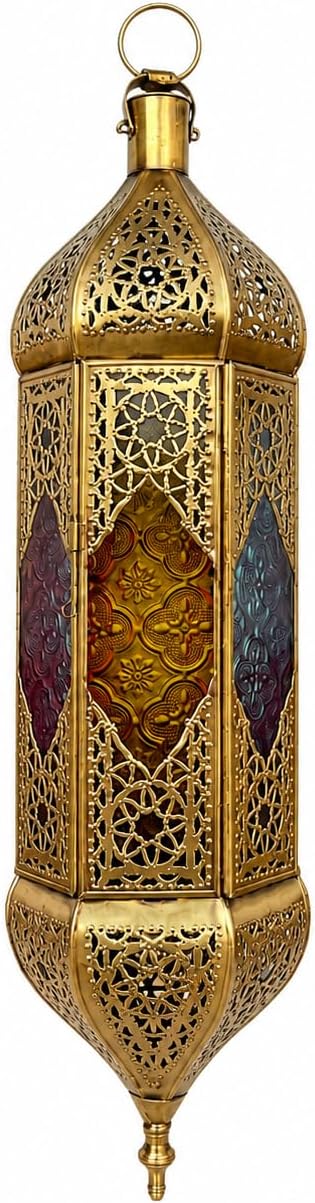
Picture yourself standing in the souks of Marrakech — the medina’s old market district — in front of a stall hung floor-to-ceiling with glowing lanterns. They’re all stunning. Some have a warm golden sheen; some glow orange-red like a sunset; others are painted matte black. The vendor tells you each one is “authentic Moroccan.” He’s probably right. But what he won’t tell you is that those three different metals will look dramatically different in your living room by year three, will require completely different maintenance, and carry very different price trajectories if you ever want to resell or trade up. This guide exists to give you the framework you’d get from a good importer contact after six months of asking annoying questions: what each metal actually is, what it does over time, and which one deserves your money given your specific use case.
By the time you finish reading, you’ll have a clear if-then decision rule — not a vague “it depends.” Let’s get into it.
The Three Metals, Defined (and Why They’re Not Interchangeable)
Brass is an alloy — a mixture — of copper and zinc. In the context of Moroccan lanterns, it’s the prestige default. Artisans in Fez (the city whose metal guilds, called maâlems, are recognized by UNESCO as intangible cultural heritage) have worked brass for centuries. Smithsonian Magazine’s 2023 feature on Fez’s craft guilds notes that brass-working families often trace their trade lineage five or more generations back. The metal is dense, machines beautifully for fine filigree (the delicate lattice cutwork you see in high-end lanterns), and develops a patina — a surface oxidation layer — that most collectors consider a feature rather than a flaw. Unlacquered brass darkens to a warm antique gold. Lacquered brass holds its bright tone but feels less alive.
Copper is the parent metal in brass, but as a standalone it’s softer, more reactive, and visually distinct. Raw copper lanterns start as a bright reddish-orange and shift, if left untreated outdoors, toward a blue-green verdigris (the same color you see on old church rooftops and the Statue of Liberty). Indoors and sealed, copper stays in the amber-to-brown spectrum. It’s popular at the mid-market tier — roughly $80–$200 — because it’s easier to hand-form than brass and strikes a warm tone that photographs beautifully on Instagram. The tradeoff: it dents more easily, the patina is less stable, and collectors in the high end of the market generally prefer brass for statement pieces.
Iron — specifically hand-forged wrought iron — is the workhorse of the Moroccan lantern world. It’s the metal behind the black-painted geometric lanterns you’ll find in every price tier from $25 at World Market to $400+ from specialty importers. Iron is heavier, more rugged, and in its painted or powder-coated form, surprisingly durable. The catch is that iron rusts. Not if, but when — especially in humid or coastal environments. A powder-coated iron lantern in a dry interior can last decades. The same lantern on a Gulf Coast patio will show rust weeping at the seams within a season if the coating chips.
Durability by Environment: Where You’re Putting This Thing Matters More Than You Think
This is the decision matrix most buyers skip, and it’s the one that causes the most regret. Per The Spruce’s 2025 guide to outdoor metal fixture care by climate, iron is the most vulnerable of the three metals to moisture and salt air, copper is reactive but stabilizes once its patina layer forms, and brass is the most corrosion-resistant of the three in typical interior and semi-sheltered exterior conditions.
The quick decision grid:
| Setting | Best Metal | Avoid |
|---|---|---|
| Dry interior, low humidity | Any; brass ages best | Nothing — all viable |
| Covered patio / pergola | Brass or sealed copper | Bare iron |
| Open outdoor / poolside | Sealed copper (with maintenance) | Iron, unlacquered brass |
| Coastal / high-humidity | Marine-grade sealed copper only | Iron, any unlacquered metal |
| Boutique hotel high-traffic | Brass (resists fingerprint oxidation) | Copper (shows handling) |
Apartment Therapy’s 2025 styling guide makes a point worth repeating: a lantern that looks spectacular in a showroom photo but requires quarterly maintenance you won’t actually do is a lantern you’ll resent. Budget the maintenance time, not just the purchase price.
Value Retention: What Holds, What Fades, What Resells
Here’s where the practitioner calculus gets real. If you’re sourcing for a client, specifying for a boutique property, or building a personal collection, you need to think about the second life of the piece — whether that means resale, relocation to a different property, or trading up as your taste evolves.
Brass wins the long game. A well-made unlacquered brass lantern from a named Fez atelier — especially one with documented maâlem provenance (meaning it comes with the master craftsman’s identity attached, not just a “made in Morocco” label) — appreciates in desirability as the patina deepens. Elle Decor’s 2024 report on what designers are actually buying in Marrakech specifically flagged hand-pierced brass pendant lights as the category with the strongest secondary-market interest among design professionals. The $300–$800 range from specialty importers like Badia Design or direct atelier commissions tends to hold 60–80% of purchase value at resale if provenance documentation is intact.
Copper occupies an interesting middle ground. In the $80–$200 tier, copper lanterns from Etsy artisan makers or Anthropologie don’t carry strong secondary-market demand — they’re priced as decorative purchases, not investments. But at the $500+ level, a hand-raised (meaning formed by hammer, not mold) copper lantern from a named workshop starts to enter collectible territory. The challenge: verifying that a piece is genuinely hand-raised versus machine-spun is difficult without handling it, and most buyers in this tier are sourcing remotely.
Iron is a use-it, don’t-invest-in-it metal. This isn’t a knock — iron lanterns serve an important function as high-volume atmosphere builders for restaurants, event venues, and layered room styling. But no one is paying a premium for a five-year-old iron lantern at resale. Budget accordingly. Buy iron for effect, brass for legacy.
By the numbers:
- Documented brass atelier pieces: 60–80% resale retention (Elle Decor, 2024 sourcing report)
- Mid-market copper lanterns ($80–$200 tier): 20–35% resale retention typical
- Iron/painted lanterns: functional value only; resale near negligible after year 3
- Brass filigree pendant lights, $300–$800: lead time from Marrakech ateliers currently 8–14 weeks (as of May 2026 importer reports)
Authentication Signals: Reading the Object, Not Just the Listing
Architectural Digest’s 2024 global maximalism feature noted that the surge in demand for Moroccan decorative pieces has driven a parallel surge in machine-made imitations — particularly in iron and copper — that are laser-cut in China or Eastern Europe and marketed as “Moroccan style.” Here’s how to distinguish the real from the replica.
On brass: Look for slight irregularities in the filigree cutwork. Hand-pierced brass — cut by a craftsman using a drill and chisels — will show micro-variations in the spacing and depth of cuts. Machine-laser-cut brass is geometrically perfect, which sounds like a virtue but actually marks it as industrial. Run your finger along interior cut edges: hand-worked pieces often show a slight burr or file mark. Ask the seller directly: is this hand-pierced or laser-cut? A reputable seller will tell you. A vague answer is an answer.
On copper: Hammer marks on the surface are a positive provenance signal on hand-raised pieces. A perfectly smooth copper surface on a low-priced piece suggests machine spinning. The seams where panels join should show solder or rivets on authentic handwork — not hidden snap-fits.
On iron: This is hardest to authenticate at a distance because the paintwork covers the metal’s story. The weight-to-size ratio matters: hand-forged iron is denser and heavier than thin stamped iron. Wiggle the joints — traditional Moroccan ironwork is mortise-and-tenon or riveted, not glued. Glued joints on a lantern you plan to hang outdoors are a liability.
The Brass-Copper-Iron Decision Rule
You’ve done the homework. Here’s how it collapses into a clear framework:
If you’re specifying for a permanent interior installation — dining room pendant, entryway statement piece, boutique hotel lobby — choose brass. The patina story, the collector-market demand, and the low maintenance in dry environments make it the right call at every tier from $150 artisan finds to $800+ atelier commissions. Insist on hand-pierced filigree and ask for maâlem documentation if you’re above $300.
If you’re outfitting a covered outdoor entertaining space or want the warm reddish glow that brass can’t deliver — choose copper. Budget for an annual wax or sealant application (Renaissance Wax, favored by conservators, is the standard recommendation in metalwork preservation circles). Accept that the patina will shift and lean into it — the color story of aged copper is genuinely beautiful.
If you’re building atmosphere at volume — a restaurant terrace, an event space, a layered boho living room that needs eight lanterns to work — choose iron. Buy it for the look, not the legacy. Powder-coat is your friend. Keep spares. Don’t put it in a coastal environment without a serious maintenance plan.
One last note: the biggest sourcing mistake practitioners make in this category isn’t choosing the wrong metal — it’s buying the right metal in the wrong finish for the environment, then being surprised when it degrades. The Spruce’s outdoor metal care guidance is blunt about this: no finish is permanent, and every metal in an exterior application needs a scheduled maintenance interval. Build that into your client proposal or your own project timeline before the lantern ships.
The lantern you’ll still love in year five is the one you chose with eyes open about what it actually is — not just what it looks like in the listing photo.