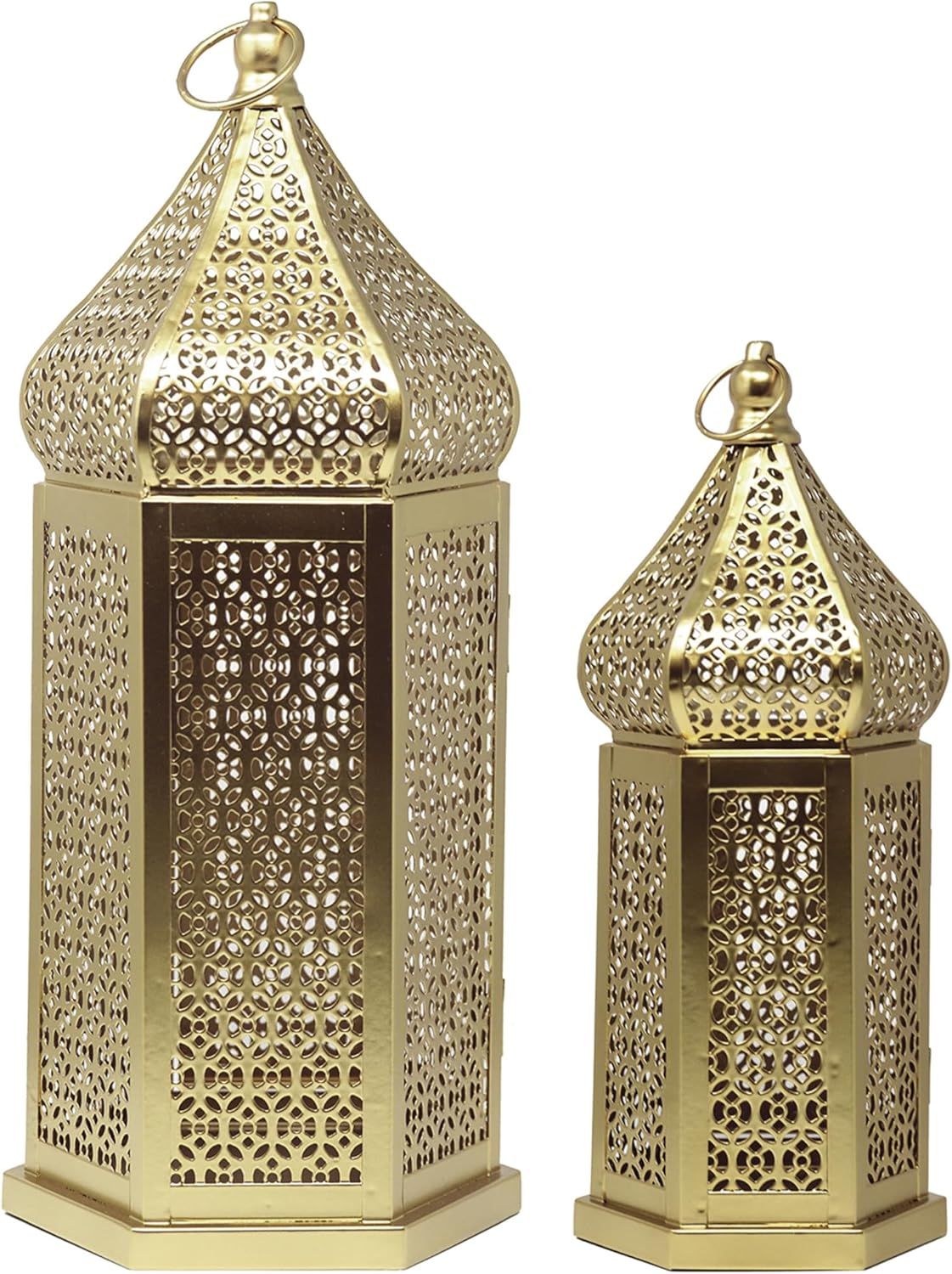
Picture this: you’re in a friend’s dining room, and there’s one hanging light above the table that stops you mid-sentence. It’s a Moroccan lantern — a hand-pierced metal pendant with colored glass panels that throw amber and green diamonds across the ceiling when the bulb warms up. The room isn’t decorated in any particular “Moroccan style.” There’s no camel-print throw, no pouf army, no souk-market wall tapestry. Just that one lantern, doing all the work. You want to know exactly which one it is and where it came from.
That’s the entire premise of this guide. A Moroccan lantern — traditionally crafted from brass, copper, or iron, with hand-cut or hand-blown colored glass — is one of the few decorative objects that can anchor a room’s mood on its own. But the difference between “the lantern that stops conversation” and “the room that looks like a Moroccan restaurant went out of business” comes down to a few very specific decisions: scale, material, placement, and restraint. If you’re mid-search right now, comparing options across Etsy, Badia Design, or a direct Marrakech source, this is the framework you need before you click buy.
The Single-Lantern Principle (and Why Most Rooms Botch It)
Apartment Therapy’s editorial series on statement-piece decorating makes the point plainly: one object chosen at the right scale earns more visual authority than five objects at the wrong scale. Moroccan lanterns are a perfect case study in this dynamic because the category ranges from a $28 tin tealight holder to a $1,200 hand-cut brass pendant — and buyers at every price point make the same mistake: they buy multiples to “fill out” the look, then wonder why the room feels costumed.
The cliché isn’t Moroccan lanterns. The cliché is too many Moroccan lanterns, scaled too small, with too little breathing room around them.
Here’s the decision frame that cuts through it:
One room, one lantern, one job. The lantern’s job is to control the light quality and draw the eye to a single focal point — a dining table, a reading nook, a bed. Every other decorative choice in the room should be quieter. If the lantern is doing its job, you don’t need the pouf, the Berber rug, and the mosaic tray all competing in the same sightline.
Elle Decor’s feature on riad-style interiors makes a related point: the designers who borrow most successfully from Moroccan aesthetics tend to take one structural element — a lantern, a zellige (the hand-cut fired ceramic tile made by Moroccan artisans called maâlem, pronounced “maa-lem”) panel, a carved plaster archway — and let the rest of the room read as relatively neutral. The Moroccan element wins precisely because it isn’t in a fight.
Choosing the Right Lantern: Material and Scale Are the Only Specs That Matter
Once you’ve committed to the single-lantern principle, the next decision tree is material versus budget versus placement. These three variables interact, and if you get the sequence wrong, you’ll spend $200 on a lantern that looks $40 in context.
Material: What the Metal Tells You About the Piece
Brass (yellow-gold, often polished or antiqued): The traditional material for high-end Moroccan lanterns, particularly the style called fanous (a term used across North Africa and the Middle East for a paneled lantern, typically featuring geometric filigree metalwork). Brass is heavy, develops a natural patina over time, and holds fine detail well. At the $150–$500 range, hand-pierced brass from Fez or Marrakech ateliers is the benchmark for authenticity. Badia Design’s sourcing notes and Shades of Light’s product descriptions both emphasize brass origin and gauge weight as primary quality signals.
Copper: Warmer-toned than brass, slightly softer, and more prone to verdigris in humid or outdoor conditions. Copper lanterns in the $80–$200 range from mid-market importers read as slightly more casual than polished brass — a better fit for outdoor dining tables or covered patios than for formal interior pendants.
Iron (blackened or powder-coated): The most affordable durable metal in Moroccan lantern production. Iron lanterns in the $40–$120 range from retailers like World Market are genuinely attractive if the glass quality is good. The tradeoff: iron is heavier for its visual presence than brass, and powder coatings can chip at mounting points. For indoor use in low-humidity environments, this is a defensible choice. For outdoor use, The Spruce’s guide to outdoor lantern materials recommends powder-coated iron only in covered spaces, citing rust risk at exposed seams in wet climates.
The glass: Hand-blown beldi glass (the Moroccan term for traditional, slightly irregular mouth-blown glass, characterized by small bubbles and gentle surface variation) scatters light in a way machine-cut flat glass simply doesn’t. If you’re choosing between two lanterns at similar price points and one specifies beldi or mouth-blown glass while the other doesn’t, the beldi piece will perform better as a light-quality object. Smithsonian Magazine’s coverage of Moroccan craft traditions notes that beldi glass production is concentrated in the Marrakech region and that the slight imperfections are a quality marker, not a defect.
Scale: The Number That Most Buyers Get Wrong
By the numbers:
- Dining table pendant: lantern diameter should be 1/2 to 2/3 the table width (a 36″ round table → 18–24″ lantern)
- Ceiling height clearance: bottom of lantern should hang 30–36″ above tabletop in dining applications
- Reading nook or bedside: a 10–14″ lantern at eye level (wall-mounted or on a surface) is sufficient; anything larger crowds the sight line
- Entry foyer: oversizing by 20% is intentional here — a 16–20″ lantern in a standard 8′ foyer reads as confident rather than cramped
Architectural Digest’s coverage of Moroccan-influenced interiors repeatedly flags undersizing as the dominant buyer error. A $180 lantern that’s 10 inches in diameter will disappear above a dining table meant for six. A $120 lantern that’s 20 inches in diameter in the same position will command the room. Scale is a multiplier on every other quality decision.
Placement Logic: Where One Lantern Wins the Room
This is where the “anti-cliché” principle gets specific. There are three placements where a single Moroccan lantern has the most authority, and one placement where it almost always fails.
Dining table pendant: the highest-ROI position. A hanging lantern above a dining table works because it defines the social zone, controls the light temperature during meals, and is visible from adjacent rooms. The fanous-style pendant — tall, paneled, with colored glass — performs especially well here because the geometric shadows it throws across the ceiling become a kind of ambient wallpaper. You need nothing else on the table except simple objects; the lantern is already the event.
Outdoor covered dining or pergola: the underused position. Moroccan brass or copper pendants in outdoor covered spaces outperform conventional exterior lighting in terms of atmosphere at a fraction of the cost of architectural fixtures. The key constraint: covered, not exposed. Brass and copper can handle humidity but not direct rain at seams. Owners in online forums for outdoor entertaining consistently report that powder-coated iron lanterns in exposed positions show rust within two seasons in coastal climates; brass-and-glass in covered pergolas regularly run five or more years without intervention beyond an occasional wipe-down.
Bedside or reading nook wall mount: the intimate position. A single wall-mounted fanous lantern at bedside, wired or battery-operated, creates a warmth that table lamps rarely achieve. The scale here is small (8–14 inches), the budget modest ($45–$120), and the impact is disproportionate. This is the position where a World Market or Etsy entry-level lantern can genuinely punch above its price because the placement does most of the work.
The position to avoid: the mantel cluster. Three small lanterns lined up on a mantel or bookshelf is the arrangement that most reliably reads as themed. Individual lanterns on a mantel can work if they’re the only decorative object on the surface and are at least 14 inches tall. But clusters signal “collection” rather than “anchor,” and collections require curatorial confidence that most rooms don’t have the supporting context to carry.
The Provenance Check: Authentic vs. Mass-Produced, and When It Matters
At the $25–$80 tier, the honest answer is: provenance matters less than scale and glass quality. A well-scaled iron-and-glass lantern from a mass-market retailer, placed correctly, will outperform a small authentic-brass piece placed incorrectly.
At the $150–$500 tier, provenance starts to carry weight — both aesthetically and in terms of durability. Hand-pierced brass from a named Marrakech or Fez atelier will hold detail at close inspection that cast-metal imports won’t. The maâlem’s mark — the slight irregularities in the piercing, the hand-filed edges on the glass channels — is visible at arm’s length, and it’s the detail that sustains interest in the object over time. Badia Design’s sourcing documentation and direct-import ateliers in Marrakech typically provide workshop origin information on request; it’s worth asking before committing at this price point.
At the $500–$1,200+ tier (large-scale pendants, bespoke commissions, architectural arrays), provenance is the product. The buyer at this level is specifying brass gauge, glass color formulation, filigree pattern origin, and electrical conversion for U.S. or EU wiring. This is where the decision to source direct from Marrakech versus through a U.S. importer involves real tradeoff math: direct sourcing typically saves 30–45% on the object cost but adds 3–8 weeks transit, customs documentation, and breakage risk (industry-standard estimates put breakage-in-transit at 8–15% for uninsured glass shipments). For a single statement pendant, the U.S. importer premium is usually worth it. For a ten-lantern restaurant commission, the direct-source math often flips.
The Decision Rule
If you’re standing at the purchase decision right now, here’s the if/then framework:
If your budget is under $120: Prioritize scale and glass quality over metal type. Buy one lantern at the largest diameter your placement can support. Skip the cluster.
If your budget is $120–$300: Brass or copper is available at this range from Etsy importers and mid-market specialty retailers. Confirm hand-pierced construction (not stamped) and beldi or mouth-blown glass. Ask the seller directly; legitimate artisan importers will answer.
If your budget is $300–$800+: You’re in provenance territory. Request workshop origin. Confirm electrical specs before shipping. If the lantern is a pendant, hire an electrician familiar with non-standard canopy hardware — most Moroccan pendants arrive with European-style ceiling roses that need adapters for U.S. junction boxes.
In every tier: One lantern, right scale, right placement. The room will tell you it was enough.