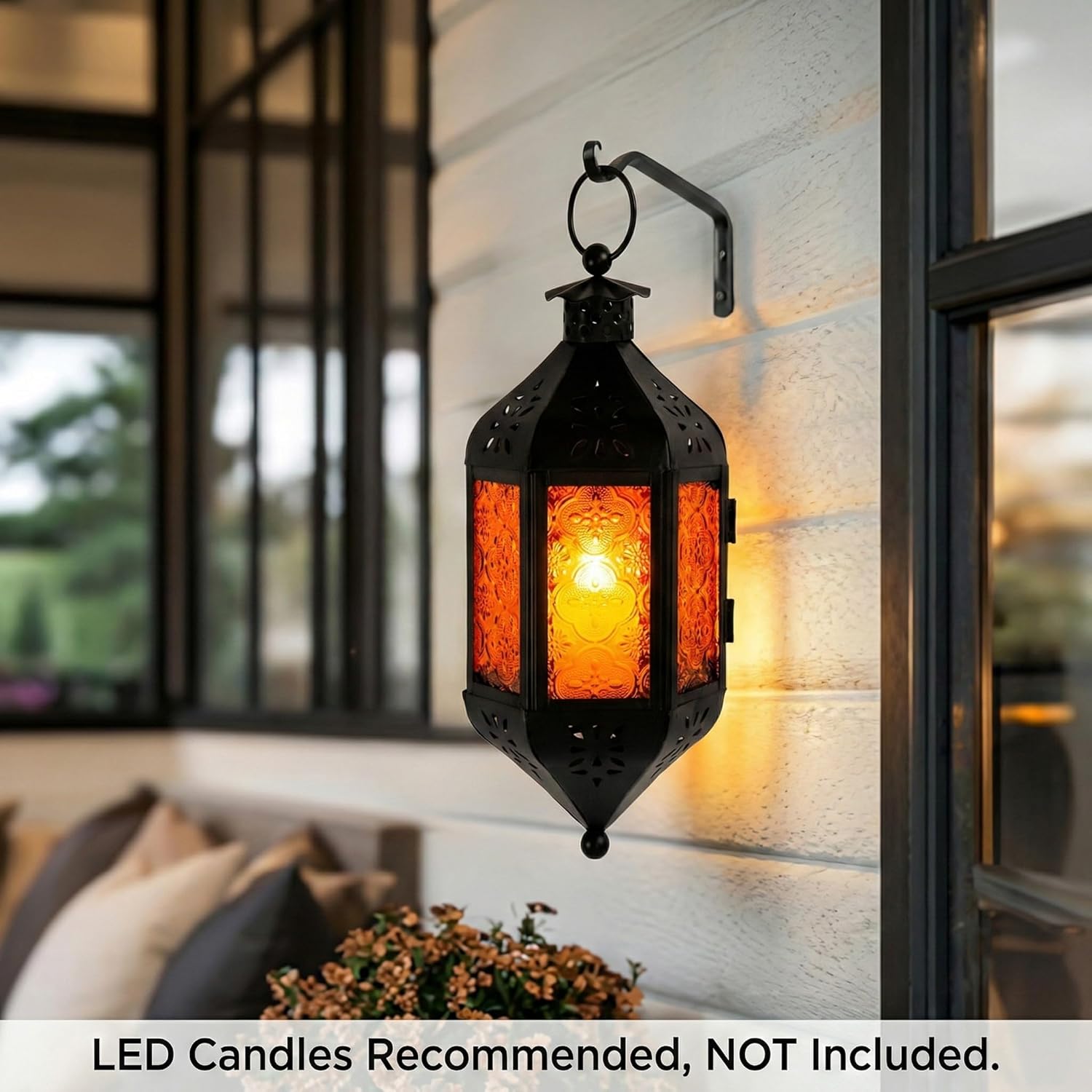
Picture this: you’ve just bought a Moroccan hanging lantern — the kind with punched-metal panels and jewel-toned glass — and it’s sitting on your dining table still in its packing tissue because you’re not sure how high to hang it or whether those amber panes are actually hand-blown or just tinted plastic. You’re not overthinking it. These are real signals that separate a $45 import from a $450 commission piece, and once you know what to look for, the choice becomes obvious. This guide decodes two underrated quality markers — chain length and glass color — alongside the metal and construction details that confirm whether you’re holding the real thing or a convincing replica. You’ll leave with a clear decision framework for your current project, not a vague appreciation for Moroccan craft.
| EDITOR'S PICK2PCS Moroccan Decorative Candle… | Mid-tier2 Pcs Hanging Hexagon Decorativ… | Budget pick[Vela Lanterns Hanging Moroccan…](https://www.amazon.com/dp/B00FN346A4?tag=greenflower20-20) | |
|---|---|---|---|
| Height | 13.8 inches | — | 11" (Medium) |
| Glass Color | — | Red & Purple | Amber/Orange |
| Metal Finish | Vintage Bronze Gold | Bronze | — |
| Chain Included | ✓ | — | ✓ |
| Indoor/Outdoor | ✓ | — | ✓ |
| Price | $28.98 | $23.79 | $18.99 |
| See on Amazon → | See on Amazon → | See on Amazon → |
Why Chain Length Is a Functional Spec, Not an Afterthought
Most buyers treat the chain as something to cut down later. That’s a mistake. Chain length on a Moroccan hanging lantern — historically called a fanous (the Arabic term for a suspended, enclosed lantern) — is calibrated by the maker to match the lantern’s weight distribution and the visual proportion of its body.
The math matters here. A lantern body that’s 18 inches tall typically ships with 24–36 inches of chain. That ratio isn’t arbitrary: Moroccan maâlems (master craftsmen, the term used for artisans who’ve completed a traditional guild apprenticeship) proportion the chain so the lantern’s widest point — usually the shoulder, about one-third down from the crown — reads at approximately eye level when hung from a standard 9-foot ceiling. Shorten that chain without accounting for the lantern’s own height, and the widest decorative band ends up above sightlines. The lantern shrinks visually. You lose the room presence you paid for.
By the numbers:
| Lantern body height | Recommended chain | Hang point from ceiling | Eye-level clearance (9 ft ceiling) |
|---|---|---|---|
| 12 in | 18–24 in | 30–36 in down | 72–78 in from floor |
| 18 in | 24–36 in | 36–48 in down | 60–72 in from floor |
| 24 in | 36–48 in | 48–60 in down | 48–60 in from floor |
Chain quality tells you even more. Authentic pieces from Fez or Marrakech ateliers use hand-forged brass or copper chain with visible hammer marks on the links — not machine-stamped uniform loops. Run a fingernail along the inside of a link. Hand-forged links feel slightly uneven; the solder joint at the link closure is often visible and sometimes slightly asymmetrical. Mass-produced chains feel slick, have no variation between links, and use a chrome or nickel plating that reads silver-cool rather than the warm yellow of brass or the reddish tone of copper.
If a listing photo shows the chain clearly, zoom in. Sellers sourcing from authentic workshops — Badia Design, or direct-import Etsy sellers with Marrakech workshop addresses — typically photograph their chain close enough to show link character. Sellers repackaging factory product rarely bother, because the chain is identical on everything they carry.
One practical note: if you’re specifying for a hospitality installation and need to standardize hang heights across a dining room, buy extra chain from the same source at time of order. Chain lot color varies between production runs, and even within brass, the patina difference between a 2024 run and a 2026 run will be visible under restaurant lighting.
Glass Color as a Provenance Marker
Here’s where intermediate buyers consistently get fooled. Color is the first thing that draws you to a Moroccan lantern — those deep amber, cobalt, and emerald panels — but the source of the color is what separates beldi glass (the Moroccan term for traditional, locally made glass, often recycled or artisan-blown, with slight imperfections that are considered characteristic) from machine-poured, uniformly tinted float glass.
Beldi glass is colored in the melt. The pigment — typically metal oxides; cobalt for blue, iron for green and amber, manganese for purple — is introduced into the molten glass batch before blowing. Because the distribution is never perfectly even, you get subtle gradation within a single pane: slightly deeper at the center, lighter toward the edges, or streaked where two batches met. Hold a beldi pane up to a light source and rotate it. The color shifts. That shift is the tell.
Machine-tinted glass — and the polymer “glass” used in the cheapest imports — reads flat. The color is the same intensity from every angle. There are no air bubbles, no thickness variations, no striations. It looks correct in a product photo. In person, under candlelight, it looks dead.
Architectural Digest’s coverage of riad-inspired interiors consistently notes that the characteristic warm flicker of a Moroccan candle lantern depends almost entirely on the glass having some imperfection — small bubbles, minor surface variation — that catches and scatters the flame differently as the candle burns down. Uniform glass produces uniform light. It’s pleasant. It’s not transformative.
Color family guide for room application:
- Amber/honey: The most forgiving. Works with warm white walls, natural wood, linen. Flatters skin tone under candlelight, which is why it’s the default choice for dining rooms per The Spruce’s Moroccan decor guides.
- Cobalt blue: High-contrast and dramatic. Reads best against white or pale plaster — the classic Moroccan tadelakt (a polished lime plaster used on walls, waterproof and slightly luminous) finish. In a room with warm wood tones, cobalt can fight rather than complement.
- Emerald/forest green: The trickiest to place. Stunning in garden rooms or against terracotta. In low-light interiors without natural green accents, it can read muddy.
- Clear with etching: Often overlooked. Etched clear beldi glass scatters candlelight as effectively as colored glass, without committing to a palette — the better choice for specifiers working in spaces where the client’s palette will evolve.
Elle Decor’s roundup of global lighting pieces that designers keep specifying flags one consistent pattern: the lanterns that appear most frequently on repeat-commission lists are amber or clear, not cobalt or green. The reasoning is practical — they layer into more palettes without requiring a room redesign to accommodate them.
Metal Finish: The Brass-vs.-Copper Decision
You’ll encounter three metals on authentic pieces: brass (a zinc-copper alloy, yellow-gold), copper (reddish-warm, darkens to deep brown with age), and iron (dark, heavier, used primarily on larger architectural-scale lanterns). Some pieces combine brass filigree — the decorative pierced metalwork — with copper body panels, or iron frames with brass accent rings.
The Smithsonian Magazine’s coverage of Moroccan artisan workshops notes that Fez has historically been the center of brass repoussé work (a technique where metal is hammered from the reverse to create raised patterns), while Marrakech workshops more commonly use iron as the structural frame with brass applied as overlay decoration. Neither is superior — they reflect regional workshop traditions, and both can produce exceptional pieces. What matters is consistency: a piece where the filigree and the body are the same metal family will age uniformly. A piece where a brass filigree overlay is spot-welded onto an iron body may show rust bleed at the weld points after two to three seasons if used outdoors.
For indoor candle lanterns specifically, this matters less than for outdoor applications. But if your client or your own project involves a covered patio or an open-air dining terrace, the metal spec becomes critical. Apartment Therapy’s buyer guidance on statement lanterns is clear on this: copper and brass both develop patina gracefully in open air; iron needs a protective lacquer coat, and budget-grade iron without lacquer will begin to surface-rust within one rainy season in most U.S. climates.
Connector hardware is the final tell. Where the chain meets the lantern crown, and where the crown meets the canopy (the ceiling plate), check whether the connecting rings are the same metal as the chain. On authentic workshop pieces, they typically are. On assembled-from-parts imports, you’ll often see a steel S-hook or zinc split ring that doesn’t match. It’s a small detail, but it’s the kind of inconsistency that accumulates: in two years, the mismatched hardware oxidizes at a different rate and the lantern starts to look cobbled together rather than composed.
Putting It Together: The Decision Framework
You’re looking at two lanterns. One is $120, listed by an Etsy seller with a Casablanca address, clear photos of the chain links, and beldi glass panels that show visible striations in the listing photo. The other is $85, domestic seller, uniform deep-blue glass, machine-stamped chain. Which do you specify?
If the project is a dining room centerpiece where the lantern will be seen at close range under candlelight: the $120 piece. The beldi glass will do things under a flame that the uniform glass cannot. The premium is real.
If the project is an outdoor string of lanterns for ambient fill lighting at a pool deck, where individual glass quality reads at 15 feet: the $85 piece may be perfectly adequate — but confirm the metal spec. If it’s lacquered iron, it’ll hold. If it’s bare iron, you’re repricing the project in 18 months.
If you’re specifying at scale for a boutique hospitality client — say, 12 lanterns across a restaurant ceiling — source all 12 from a single lot, same workshop, same batch. Sellers like Badia Design or direct Marrakech importers with wholesale programs can guarantee batch consistency in a way that individual Etsy orders cannot. The color variation between two beldi-glass production runs is charming in a residential setting. In a commercial dining room, it looks like a mistake.
The final rule: chain length tells you the maker understood the lantern; glass character tells you the glass blower understood the fire. If both are right, the price difference between a good piece and a great one is almost always worth it.