Walk into almost any home goods section that carries Moroccan-style lighting and you’ll see the same thing: that tall, arched silhouette with a pointed top and geometric cutouts — the shape most people picture when they hear “Moroccan lantern.” It’s called a swan neck or fanous (Arabic for lantern, pronounced fah-NOOS), and it’s everywhere for a reason. It works. But stop there and you’re leaving a serious slice of the form vocabulary on the table. Moroccan lamp-making — a craft tradition centered in Fez, Marrakech, and Tetouan — actually produces a much wider range of shapes, each with its own name, functional logic, and room-fit. This guide covers the specialty shapes that experienced buyers keep discovering: moon lamps, globe lights, cylinder forms, star-cut pendants, and a few others that don’t have clean English translations yet. By the end, you’ll have a decision frame you can apply to your next sourcing call or spec sheet review.
The Shape Vocabulary You Actually Need
Before the comparison work, a quick glossary. These terms appear on Etsy listings, Badia Design spec sheets, and direct Marrakech atelier invoices — knowing them saves real back-and-forth.
Fanous (فانوس): The catch-all Arabic term for lantern. When a listing just says “fanous,” it usually means the classic tapered hexagonal or octagonal form with a pointed finial. That’s the swan neck family.
Beldi (بلدي): Literally “of the country” or “traditional.” When applied to glass, beldi signals hand-blown, slightly irregular, recycled-glass technique from artisan cooperatives, most commonly around Marrakech. Beldi glass has visible bubbles, color variation, and uneven thickness — all markers of authenticity, not defects.
Maâlem (معلم): Master craftsman. A maâlem-stamped or maâlem-attributed piece signals that a recognized guild artisan led its production. Smithsonian Magazine’s coverage of Fez artisan traditions notes that the maâlem designation is the closest analog to a journeyman-to-master certification in Western trades.
Zellige (زليج): Hand-cut glazed terracotta tile, fired in Fez. When zellige appears on a lamp base or surround, it’s structural ceramic, not paint or printed pattern. Fez-fired zellige carries a specific crazing pattern and color depth that ceramic-lookalike imports can’t replicate.
Now, the shapes that go beyond the fanous.
Moon Lamps: The Shape That Does the Most Work in Small Spaces
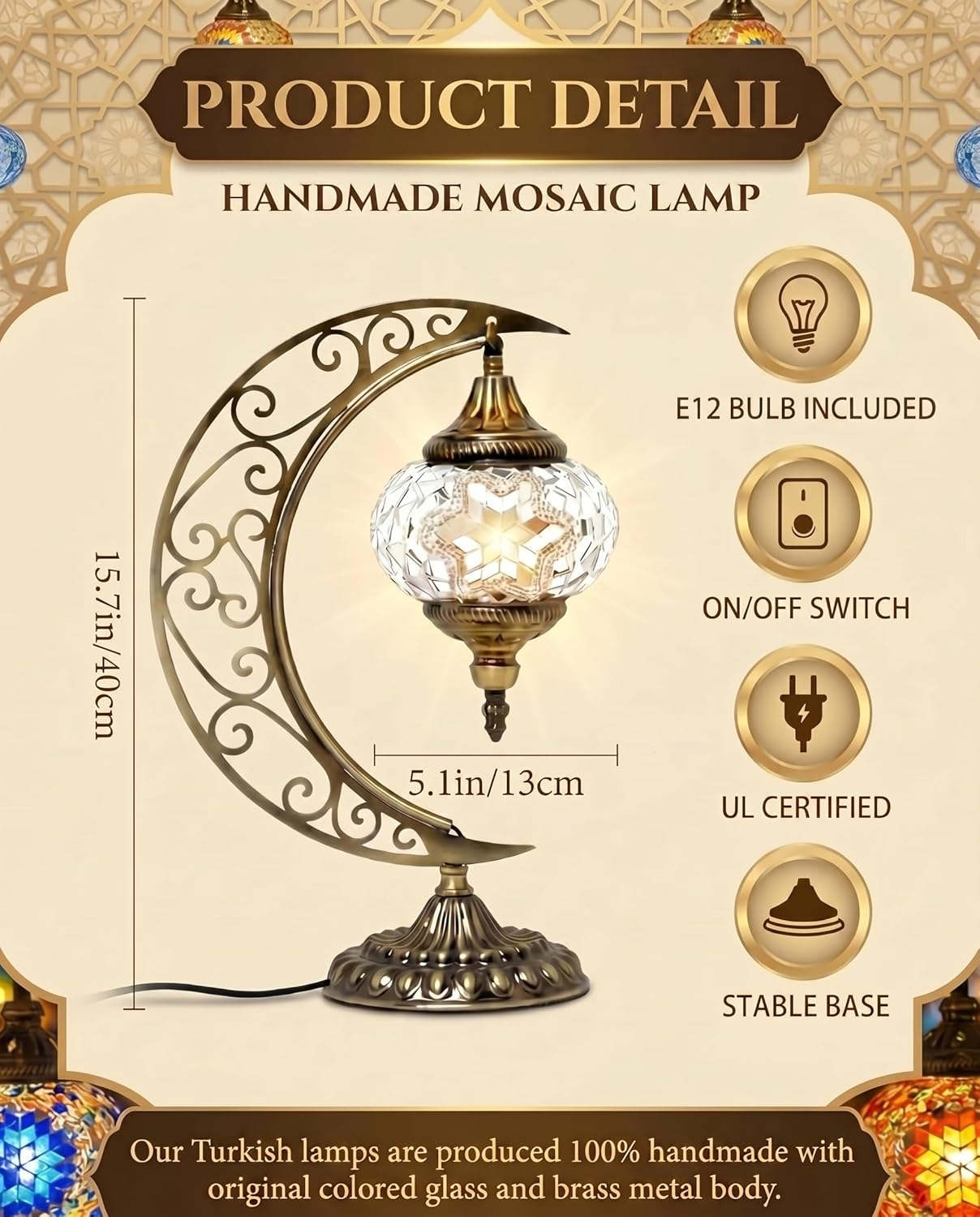
A moon lamp (sometimes listed as “Moroccan crescent pendant” or “hilal lamp,” from the Arabic word for crescent) is a partially spherical or D-shaped form, flat on one side, with filigree cutouts across the curved face. Hung flat-side against a wall or ceiling plate, it throws a projected pattern — stars, arabesques, or geometric lattice — across one surface rather than radiating in all directions.
That directionality is the functional argument. In a dining nook, a powder room, or a boutique hotel bedside alcove, you often want atmosphere on one wall, not ambient fill. Moon lamps solve that without a directional track fixture.
The tradeoff to name explicitly: Moon lamps are almost always hardwired pendants or plug-in sconces — they’re not interchangeable with the candle-holder fanous a client might also be considering. If your spec calls for candle-safe (real-flame) use, the curved enclosure traps heat and most moon lamp housings aren’t rated for it. Stick to LED conversion or low-watt incandescent for these.
Price reality check (May 2026 market): Entry moon lamps in brass-finish iron with machine-cut patterns run $45–$85 on Etsy and at World Market. Genuine hand-pierced brass moon lamps from Marrakech ateliers or specialty importers like Badia Design start around $180 and move toward $400 for larger diameters (14 inches and up). The visual tell between tiers is edge finish on the cutouts: machine-cut leaves a clean, identical bevel on every aperture; hand-pierced shows micro-variation in depth and a slightly burnished rim from the chisel work.
Globe Lights: When You Need the Whole Room to Glow
The Moroccan globe lamp is a full sphere — no flat side, no point — with cutout or inlaid glass panels distributed evenly around the form. They hang as pendants, cluster in multiples, or sit as tabletop accent pieces on a weighted base. In the riad-inspired living rooms that Elle Decor’s coverage of the new maximalist interiors calls “lantern-anchored,” globe pendants are doing the heavy lifting because they throw light in every plane simultaneously.
The design logic here is additive: one moon lamp reads as a mood moment; three globe pendants clustered at varying heights read as an architectural feature. That’s the spec distinction that matters for hospitality clients. A boutique hotel lobby specifying a four-globe cluster over a seating group is making a different investment than a homeowner buying a single globe for a reading corner — but they’re sourcing from overlapping parts of the market.
Brass vs. copper vs. iron — the globe edition:
| Frame material | Typical price multiplier vs. iron baseline | Outdoor durability | Patina behavior |
|---|---|---|---|
| Iron (powder-coated) | 1× | Good with coating intact | Rust if coating chips |
| Brass | 2–3× | Excellent; naturally corrosion-resistant | Warm honey-to-verde over years |
| Copper | 2.5–3.5× | Excellent | Green patina accelerates in coastal/humid air |
For covered patio or interior use, iron is a defensible budget call. For pool-deck or coastal-exposure specs, The Spruce’s Moroccan lantern buying guide flags brass and copper as the materials worth the premium — iron’s powder coating degrades faster in high-humidity, salt-air environments, and recoating a globe form is labor-intensive.
Beldi glass insets in globe lamps: This is where the mid-tier buyer has the most leverage. A globe with hand-blown beldi glass panels — irregular, bubble-flecked, slightly rippled — costs $120–$250 more than the same form with flat machine-cut glass, but the light quality is meaningfully different. Beldi glass diffracts rather than transmits, so the globe glows rather than spotlights. Across aggregated reviews of Etsy’s mid-market globe sellers, owners consistently describe the beldi-glass version as “warmer” and “less harsh at night.” That’s worth naming on a spec sheet when you’re helping a client choose.
Cylinder, Star-Cut, and Low-Profile Specialty Forms
The cylinder (or baraka form): A straight-sided, open-top cylinder in brass or copper, usually 8–16 inches tall. The cutout pattern wraps the full circumference. As a table lamp base or a floor candle holder, the cylinder is the most architecturally neutral of the Moroccan specialty shapes — it reads as global-modern as easily as it reads as Maghrebi. Apartment Therapy’s 2025 interiors trend coverage noted the cylinder silhouette gaining traction specifically among designers who want the craft provenance of Moroccan metalwork without the visual loudness of the fanous point. That makes it the right call for a client who loves the material but is anxious about over-theming.
Star-cut pendants (khatam geometry): Khatam (خاتم) refers to the eight-point or twelve-point star pattern derived from Islamic geometric tradition — the same underlying math as the tile work on mosque floors. A star-cut pendant is a faceted metal form where every panel is cut to present a star aperture to the viewer regardless of angle. They’re the most technically demanding of the specialty forms to produce: each facet requires precise angle-matching at the join, and hand-soldered brass khatam pendants from a recognized maâlem can take days per piece. Architectural Digest’s sourcing coverage notes that khatam-geometry lanterns are among the first forms to be faked convincingly at the low end — machine-stamped versions look similar in listing photos. The inspection tell: run a finger along the interior join lines. Stamped forms have a uniform, slightly raised seam; hand-soldered joins show micro-variations in solder fill and occasional thumb-press marks from the finishing stage.
Low-profile flush or semi-flush forms: Less common in the North American market but standard in Moroccan residential builds — a shallow domed or disc form that mounts close to the ceiling. If you’re specifying for a space with ceiling heights under nine feet, the fanous pendant is often too tall to hang at an appropriate eye-clear height. The low-profile disc form solves this. Most importers carry it by request rather than standard stock; Badia Design and direct Marrakech-sourced ateliers are the most reliable channels for this form in the $200–$500 range for brass.
Decision Rules: If X, Then Y
You’re mid-sourcing. Here’s the frame:
If the space has one focal wall and you want pattern projection: Moon lamp, single pendant, flat-side to wall. Budget $180+ for hand-pierced brass if the piece will be seen up close.
If the spec is a cluster installation (3+ pendants) over a dining or lounge zone: Globe pendants at varying cord lengths. Specify beldi glass if the budget allows — the diffused glow reads better in cluster arrangements than clear glass, which can feel like overhead interrogation at table height.
If the client is anxious about over-theming but loves Moroccan metalwork: Cylinder or low-profile disc form in unlacquered brass. The silhouette is calm; the craft story is still there.
If the project is outdoor-exposed (pool deck, coastal patio, humid climate): Brass or copper frame only, regardless of form. Don’t let an iron-framed piece go into that environment on budget grounds — the replacement cost and labor will erase the savings within two seasons.
If the budget is $80–$150 and authenticity markers matter: Focus the spend on beldi glass quality over frame material. A hand-blown glass insert in an iron frame is more defensible than machine-cut glass in a brass frame — the glass is what the eye reads at night when the lamp is lit.
If you’re sourcing direct from Marrakech for a single statement piece: Request the maâlem’s name and workshop district in writing before committing. Authentic atelier production in Fez’s medina and Marrakech’s Sidi Ghanem district is documentable; a seller who can’t name the workshop is almost certainly brokering mass-produced pieces. That provenance detail is also your differentiating story for a hospitality client who will want to tell it to guests.
The swan neck fanous is a great lamp. It earned its ubiquity. But once you know the rest of the vocabulary — the moon, the globe, the khatam star, the cylinder — you can match shape to space instead of defaulting to the same form every room. That’s the shift from competent to authoritative in this category.